Should Canada Break Up?
What is Canada? And should we call it quits?

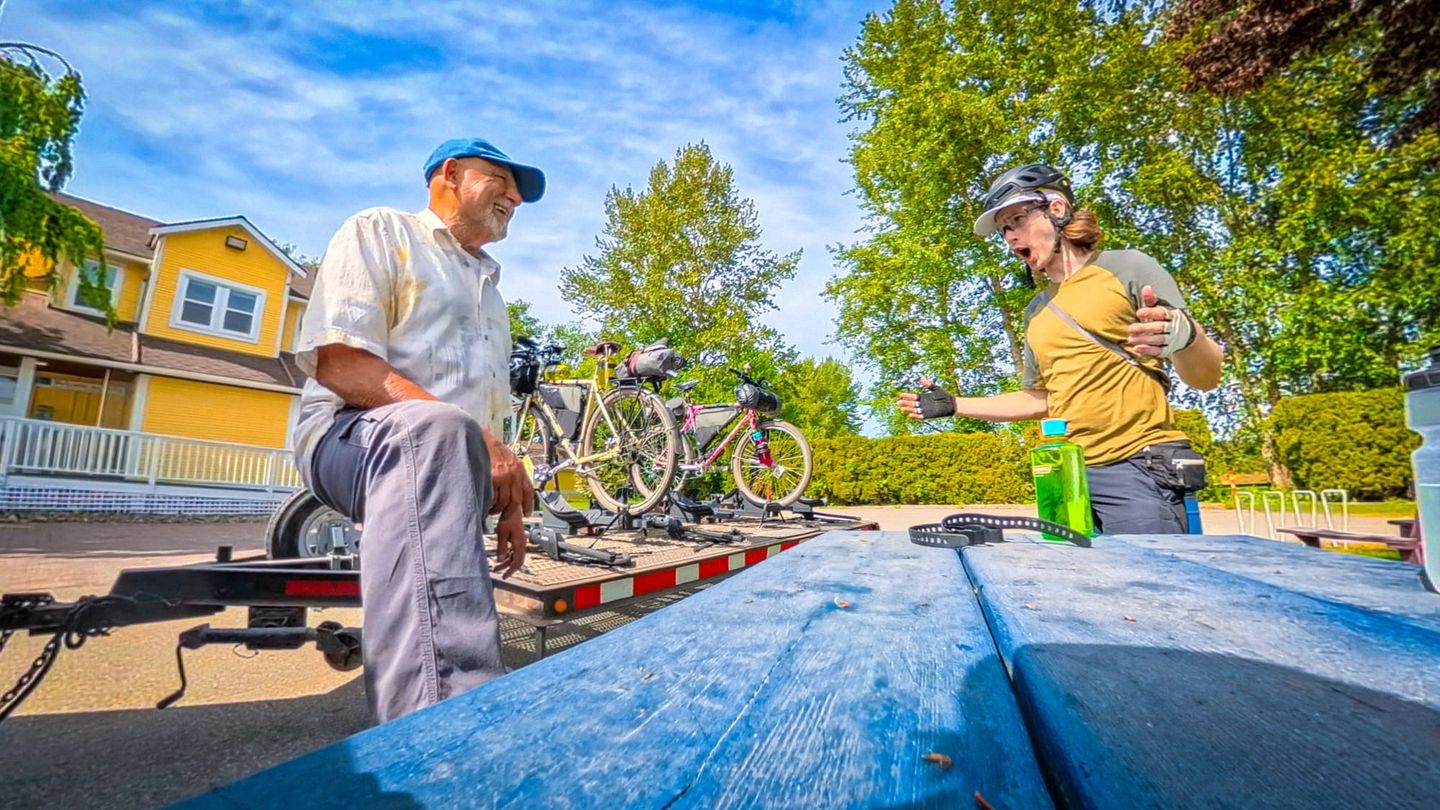
Ali wasn’t African.
At least that’s what he told us. He might have been born and raised in Tanzania, but people around him were racist. His skin wasn’t as dark, his family was middle eastern, and eventually he moved to Canada. Now, at 76 he drives the shuttle from Richmond to Delta while doing three days landscaping per week– he gets by, but not much more.
He’s worked a lot of jobs. We asked him if he’s ever faced racism here.
"When I was a bus driver, I only had four racist incidents.” Jay laughed. I commented that it was still four too many. Ali shrugged. Four wasn’t so bad– he’s been here for more than fifty years. Nonetheless, he remembers all of these incidents and when they happened. We didn’t press him for details.
May 7th. I landed in Vancouver for the trip that Blue Jay Walker and I had been planning for six months. I flew with my bicycle in a box. We built it at the airport. It was a disaster; It was day minus 2 and we needed to get to Victoria to start our trip. We would leave the next day.
I went to bed at midnight. Because of the time change, I had been up for 24 hours straight. After three or four hours, I woke up.
May 8th. Day minus one.
Tomorrow, the real trip would start. Still, we had to bike to the ferry to get to Victoria. Mile 0 BC to Mile 0 Newfoundland.
Victoria was a ferry ride away. To get there, we had to go through the George Massey tunnel using the shuttle service.
It was 12:15pm. We would have left earlier, but we were still prepping. Six months of planning was insufficient for the reality of the journey. The next shuttle was at 1:00pm, and it was 21km away. It didn’t matter how long we’d been training, there was no way we could bike 21km in Vancouver in 45 minutes. Instead we opted to leave at 1pm and catch the 3pm shuttle, with the hopes of catching the Ferry to Schwartz Bay by 5pm.
The inconsistency of the shuttle is frustrating, and since there are no other options, everyone who wants to bike to Vancouver Island is forced to rely on this shuttle.
For years, the city has claimed that they would build a new way for bikes to get through the George Massey tunnel. As a temporary solution, they made a shuttle service.
Five years or so later, the temporary option is permanent. Easier to create a bandaid than to make an investment.
We tried to clamp down our bags and get out of the front door, but even then we struggled to know whether we were ready. Some of our systems were proving less than efficient, like Jay’s hairbrained idea to strap our water bottles to the front tire. The water proved to be inaccessible, unbalance our bikes, and even scratched up Jay’s paint job.
Because I was so tired, I struggled to keep up with Jay.
We pulled up to the shuttle, significantly more confident than we had been 21km beforehand. The shuttle was unmanned, and we weren’t sure what to do. The sign beside it had a phone number, and we called it.
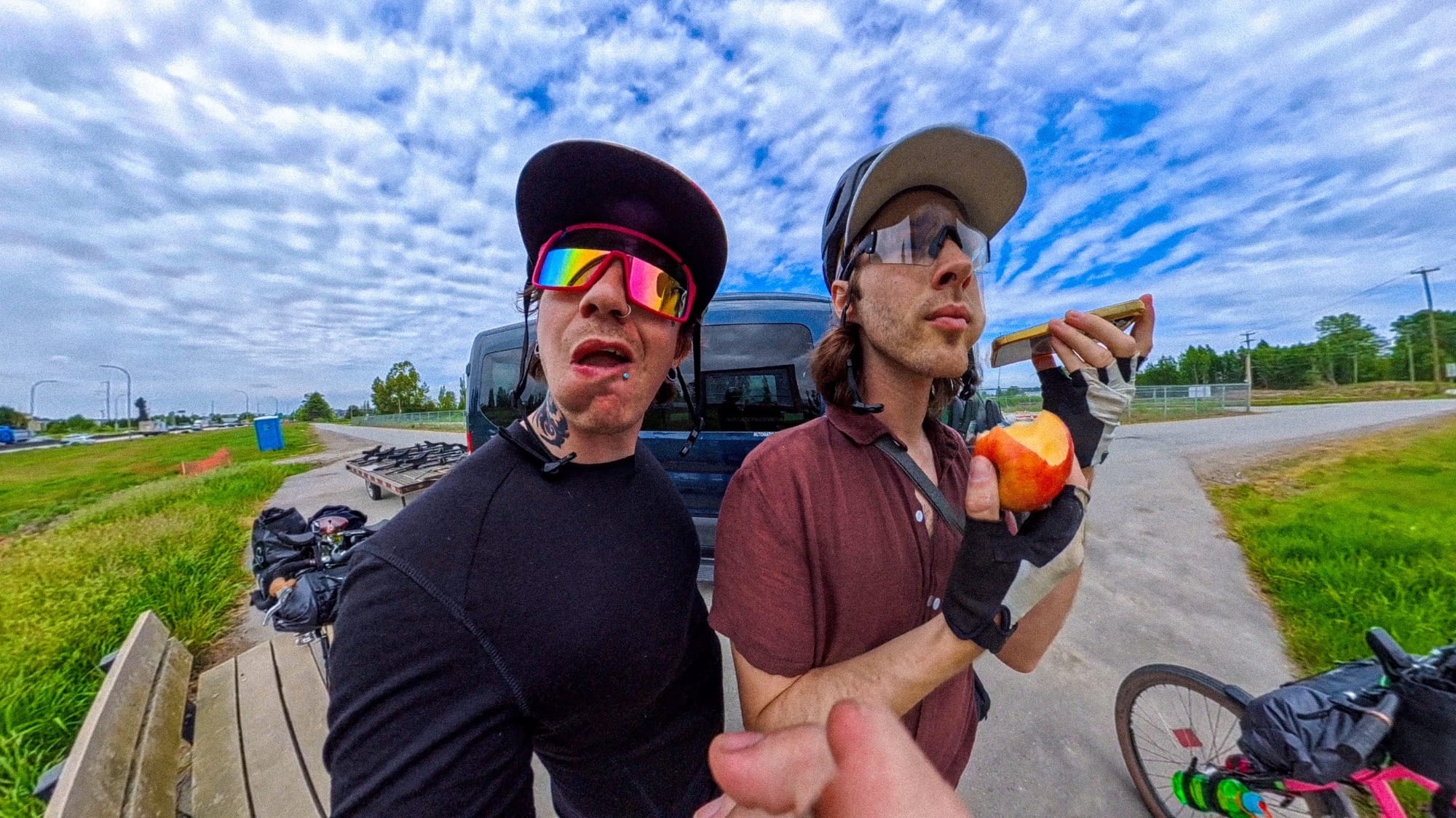
“Yeah, sorry, I’m not sure what to do,” the man on the other side of the phone told Jay. Although this man worked for the shuttle service, he didn’t know much about it.
“The schedule says 3pm, and it’s 3 right now,” Jay said to the man. “But there’s not a driver here.”
“Uhhh...” the man on the phone groaned back. “I’m checking the website.” He confirmed that there was a scheduled shuttle at 3pm. He then informed us that he didn’t know anything else.
At that exact moment, Ali showed up in his car. He immediately charmed us. A 76 year old, sharp as a whip. We loaded our bikes onto the trailer, and hopped in the car.
“A home invasion style robbery,” the radio blasted as Ali turned on the van. “The DNA, cellphone and records were linked to the three killings.” It seems that the murders weren’t planned, it was a botched robbery. Jay and I shared a glance and smiled.
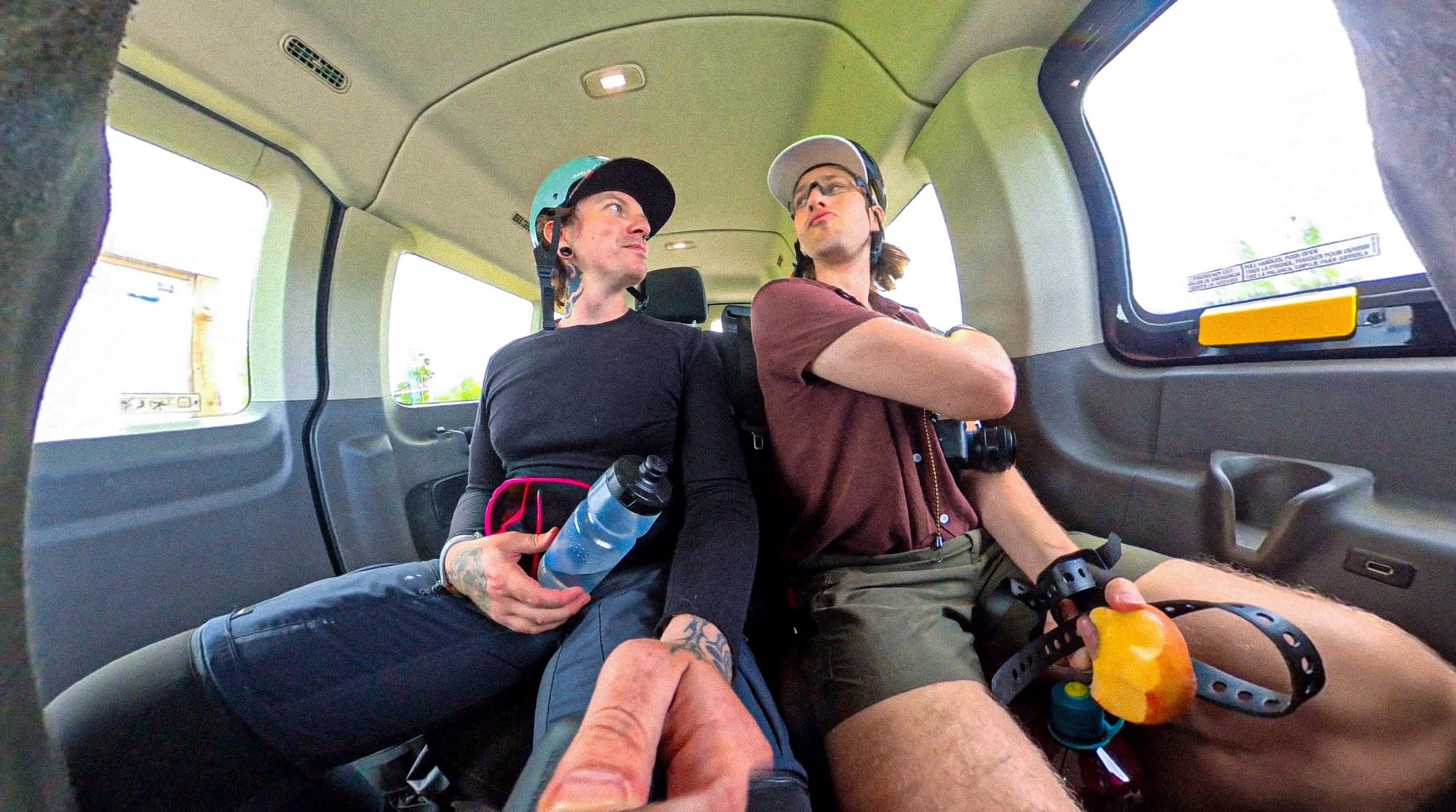
Eventually, Ali turned off the radio and started chatting again. It was more enjoyable for all of us. Ali had us laughing the whole time. His charm was magnificent. He told us stories of how he tried to climb up Kilimanjaro twice, and failed. He complained about his friend, who was $15,000 in debt because he leased a semi-truck. He made fun of the £10 note that I had in the spokes of my bike.
For Jay and I, it was a perfect moment. Ali was the reason we went on this trip. He was this illogical construction of disparate life experiences, a man whose worldview was not linear, sometimes regressive but in the end we loved him. We loved him in the way that you can only love someone who you meet in a flash, a moment that will disappear too quickly. Ali was everyone whom we’ve ever known— a complex individual who has no real rhyme or reason. He’s a collection of strange stories, decisions, and consequences.
He wasn’t born in Canada, but he’d been here for decades. He was a citizen, and a neighbour, a friend and a jokester. He speaks multiple languages, and has friends and family.
We started biking to find Canada. We found it in that shuttle ride.
Between those jovial moments, Ali mentioned something I remarked on. In 2021 he ran away from his family. At another point he mentioned that he had 15 roommates and told us where he lived, which Jay remarked on. Our conclusion was that Ali was a recently divorced man, living out the twilight of his life as a shuttle driver. His son lives in Halifax, and they love each other.
At 76, Ali was starting a new life.
And when he dropped us off, we shook hands and continued biking.
We will probably never see him again.
Jay and I have begun our trip. We’ve been planning it since December. It started something else, but turned into a journalism project that would dwarf the ambition of many others that we’ve done.
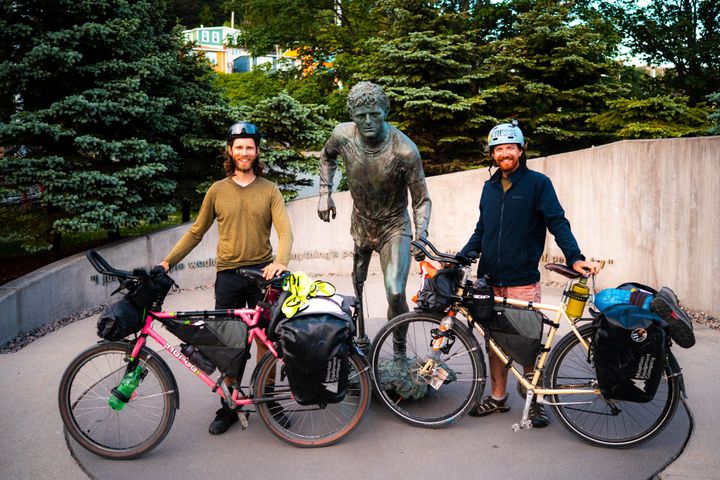
Jay (also known as Blue Jay Walker) is the editor and chief of the physical only magazine, The Paper Rag. We’ve worked together for a decade now, first in Australia, then in a punk band, and now as journalists. We’ve had a parellel path in our lives, with almost identical interests and a remarkably similar personality— but we look nothing alike.
Fundamentally, all countries are a constructed reality. They’re fact only so long as everyone agrees that they’re a fact. What is Canada now didn’t exist until the British colonized it. Before that, it was a landmass with disparate groups now known as Canada’s First Nations; it wasn’t a unified nation-state.
But really: Should Canada exist?
Yves Francois-Blanchet, the leader of the Bloc Québécois called Canada “an artificial country with very little meaning.” His comment came during the election, when most Canadians were anxious about American imperialism and annexation.
Canada has faced its own dissolution several times. What we know as “Canada” today didn’t exist until 1949 when Newfoundland became the 10th province of Canada. At first, “Canada” was only Ontario and Quebec. Confederation was John A. MacDonald trying to counter American influence on this British colony, and to create a united front after the American Civil War.
What then, is a country? And what does it mean to be part of a country? Specifically, what does it mean to be part of Canada?
Famously, Alberta and Quebec are openly critical of each other, with little love lost between the two provinces. So why are they under the single banner called “Canada?”
We decided that the only way to answer that question was to go across the country and find it ourselves. We could do it in a van, but we wanted to touch ground no matter where we were. We have been taking hundreds of photos (both film and digital), filming videos, talking to strangers across the land, and are writing up a storm.
We put this trip together so we could do something a little different— something that hasn’t been done in Canadian journalism before. We are going to use gonzo journalism, and tell the story of a strange nation. Some of these stories will be people like Ali, and others will be about the cabin in the woods, or the mountains staring down at us, towering above us as they have for thousands of years. These stories are the connectors of a country that is in peril.
This year there may be a referendum on Alberta separation, and soon thereafter there may be a referendum on Quebec’s. Canada is exceptionally polarized right now— look at opinion polls. The only colours on there are blue and red.
A report came out today that the Prime Minister has received hundreds of death threats since taking office. Prior to Trudeau stepping down, people were calling for his execution, and carrying flags that said “Fuck Trudeau.”
A country where hundreds of threats are being sent to the democratically elected leader, and where the chance of provinces splitting into their own individual countries does not speak highly of a healthy society.
Worldwide, right wing extremism has infected political systems, and it’s plain to see that the western dominance that has so long been taken for granted by westerners is upended.
The United States has elected a fascist leader, and although their system remains “democratic,” they elected him twice. America is not the leader of democracy they claimed to be in the 20th century.
Democracy is not well. Canada is sick, and although we want to ignore it, if we don’t address this sickness, it could become terminal.
So, on May 9th we started this collaboration. On the Trail and The Paper Rag have combined to create The Paper Trail. For the next two months, we will be releasing podcast discussions from the road, and at least two articles a week— one from me, and one from Jay (he is an excellent writer.)
It will be Gonzo journalism. (Gonzo is a style where the journalist is a part of the story, and you are meant to experience the story through their eyes.)
These stories will be frank. It will be discussions, and hard times, and we will show you a Canada that you don’t know— we will talk to people you don’t like and listen to them. We will publish words that we don’t agree with, and we will show you the Canada that we see with our own eyes as we traverse the country with our two legs. The coolest part about it all is that these will all be published physically at the Paper Rag at the end of the month. Go sign up for the physical edition as well.
Most of these articles will be behind a paywall. This one is not, because we want you to see what we’re doing. We’re hoping to give you the two best, and most enjoyable months of journalism you have ever read. We hope we succeed, and we are extremely excited to share this with you.
Over these next two months, we will find the answer to the question:
Should Canada break up?
Join the conversation