Liberal return to office order a “handout” to banks: CAPE
Internal documents reveal that they could save up to $40 billion over ten years if they cut up to 70% of in person work.


During the Pandemic, businesses and government began to adopt a remote work strategy. It allowed people to work from home, tending to their kids, their dogs, to eat healthier by cooking during lunch, and to continue getting their jobs done.
Today, that reality is dead.
Companies are demanding that people return to work in person, despite strong resistance. Restaurants in downtown cores are lobbying to have office workers return, as their biggest business comes from lunch goers. And considering everything is via the internet, why shouldn’t this be the case?
The government has been following suit.
Austerity
As the Mark Carney Liberals implement a major policy of austerity, cutting up to 40,000 public sector jobs, one of the largest federal public service unions in Canada believes that the return to office orders by the Mark Carney Liberal government is being done in order to protect real estate value.
“While Prime Minister Mark Carney talks about building a strong economy, his actions show clear choices to weaken the public service, prop up an economic reality that’s inaccessible for most Canadians, and make it easier for profit-first private interests to move in when public systems are under strain,” Nathan Prier, president of the Canadian Association of Professional Employees (CAPE) said. They “believe Carney’s main motivation for RTO is to give a handout to four big banks to protect their roughly $10B of commercial real estate.”
Return to Office (RTO) orders are becoming the norm for businesses nowadays. The main reason? Real estate in downtown office buildings, whether for banks or for government services, has lost some of its value. Any company who owns an office is suddenly seeing that investment struggle— along with it, businesses in downtown cores can’t pay their rent. As people return to in-person work, the price for commercial real estate is once again rising.
The government’s shift towards RTO orders is a divergence from the Trudeau era, where reducing office mandates was projected to save money, as well as reduce carbon emissions nationally. In an internal document received by an access to information request, the government’s own research shows that up to $40B dollars could be saved through continuing work from home policies.
“Under a 50% office space reduction scenario, Public Spaces and Procurement Canada (PSPC) anticipates that it will fully meet… carbon net zero of its Crown-Owned assets in 2032,” the document says. It goes on to add that with a 70% reduction in the use of office space there could be a “cost avoidance from the status quo of… $39.10B with a 70% reduction over ten years.”
The RTO orders have required the federal government to purchase two new buildings, and reverse policy. CAPE believes that this isn’t a bailout of commercial real estate, but a handout to the big banks. “It's 40 billion dollars for people to go back to work and be less productive, more emissions, more people on the road,” a spokesperson for CAPE told On the Trail. They explained that Carney is ”socializing private risk while the taxpayers and workers really get nothing in return other than a promise to have these industries continuing to operate in Canada— but no guarantee of taxpayer return.”
Protecting Private, Defunding Public
If the Carney government is protecting banks, it could be related to their deep relationships that are well established through near constant lobbying.
These banking institutions lobby almost every single part of the government, and have one of the most successful and well oiled lobbying machines to get what they want from government action. Using the IJF’s lobbying registry and matching it with our own, we see that every major bank has lobbying going on for a variety of subjects, although there is nothing specifically related to commercial real estate mentioned in these files that we have found.
Still, the Liberal government is quickly moving to cut public spending and put much taxpayer money into the pockets of private fossil fuel based companies, opposite to the values outlined in Mark Carney’s book of the same name. Meanwhile, as the Liberals prioritize fossil fuel subsidies, major cuts to the public service are ensuing. The CCPA estimates that the public sector had finally reached a sustainable level that would properly serve Canadian needs, and cutting their services will have a major impact on Canadians.
There is an outsized impact specifically on women and indigenous services, which have been widely condemned by indigenous groups across Canada, and seem to be heading towards greater conflicts.
Services that are being seriously impacted by cuts include: Crown-Indigenous relations ($7.2B in cuts), Indigenous Services Canada ($3.684B in cuts), the Pharmacare program, the Childcare programs, Nature Legacy Program, Chemicals Management Plan, the National Adaptation Strategy, Health Canada ($3B in cuts), as well as Asylum seekers and refugees receiving less comprehensive health care.
Collective Action
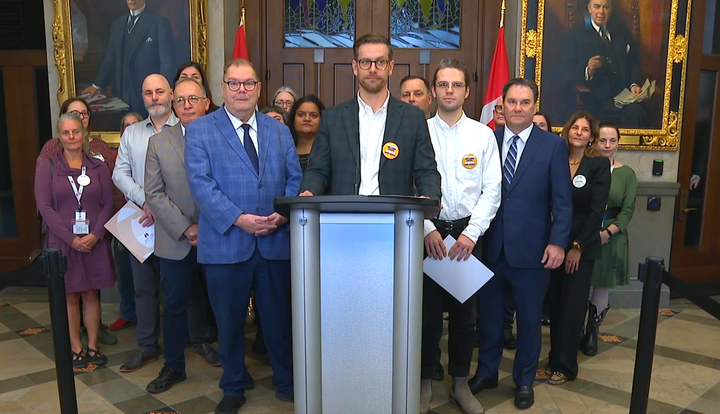
In response, CAPE is holding a protest outside of the Prime Minister’s office, across from Parliament. Their goal is to make the Prime Minister “respond and tell the truth about this.”
So far, the government sector has struggled to get sympathy from the broader public. A disinformation campaign has taken place to discredit their work, and make their struggle seem less important than it is. It’s all too easy to look in a comment section about public workers and see the grievances of individuals that feel the public sector incentivizes lazy workers and low quality production.
Ever since more workers have begun being laid off, people have been struggling with overwork and burnout. The problem is getting worse and workers are asked to do more with less, and asked to use AI tools to compensate for a smaller workforce— AI is highly distrusted by Canadians, and poses serious security concerns.
CAPE wants power to be back in the hands of the people, and although the public hasn’t responded with sympathy, they believe that they can get people back on their side when taxpayers realize their money is being mismanaged.
“The plan is to continue the pressure campaign on Carney and the banks to tell the truth into the summer, while talking about the impacts that all Carney's public service cuts are having on different departments, but also on Canadians' standard of living,” Prier said. “Also, CAPE’s largest groups head into bargaining this fall. CAPE’s members have chosen conciliation for the first time, which does leave the door open to labour action.”
“The campaign is geared towards the taxpayers. It's meant to mobilize more workers. We're bargaining this year and next year,” The spokesperson said. “The public right now has been saying ‘oh, boo-hoo, you have to go to back to the office, I do too.’ What we're trying to say is ‘no, you're getting screwed, and workers are getting screwed.”

Join the conversation