Willing to die
The harrowing life of being a firefighter, and the irresponsible government which propagates these disasters

THIS ARTICLE IS FREE FOR EVERYONE - IF YOU WANT TO SUPPORT TRULY INDIE JOURNALISM, TRY OUR 2 WEEK FREE TRIAL, OR SUPPORT US FOR AS LOW AS 3$ A MONTH
If a tree falls in the forest, will anybody get crushed?
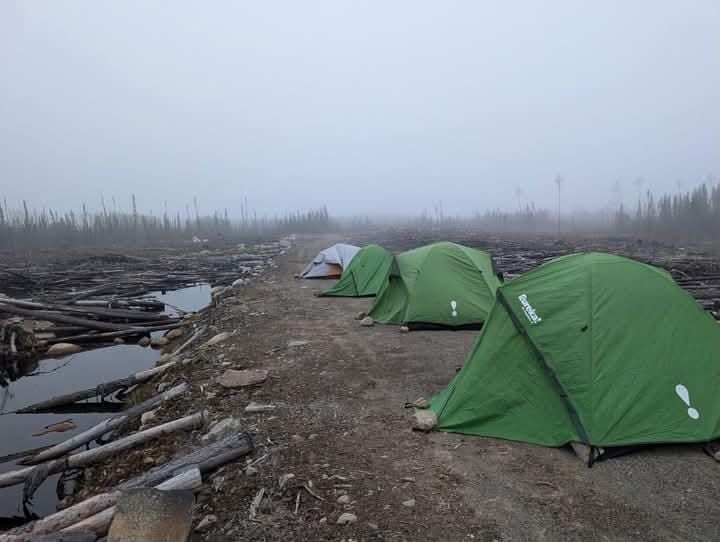
Vasilious was flagging smoke for his crew on the front lines. Fourteen days in the trenches to stop the fires from spreading further; the worst fires in Canadian history burning as the south choked in smoke. He turned around and walked ten paces forward, when behind him he heard a crack. A forty five foot tree came crashing down where he had been moments before. "This tree just comes crashing down over top of the line exactly where I was standing. That could have been me if I was a little bit slower," he said. After the moment of adrenaline subsided, bad thoughts started creeping into his head, the realization that he could have been taken out in an instant, but he narrowly avoided it.
He's seen friends have trees fall on them as well.
"The roots of a tree will be all burnt out and you'll be looking at the tree. It'll look fine, right? And then all of a sudden, your buddy's screaming, you turn around and he's got a tree on top of him." A lot of trees fall. A lot of close calls occur.
Everyone is affected
These wildfires affect everyone in Canada. They affect Americans. They will affect the world as the smoke puts more carbon into the atmosphere and causes a vicious cycle of worsening climate conditions for the whole world. But the people on the front line working to stop these fires from hurting more people than they already do are underpaid, underappreciated and doing the work out of a sense of duty rather than any sort of remuneration.
Wildfire fighters have jobs seven to eight months a year, and are paid piddly amounts that don't cover the basic. $26 dollars an hour as well as standing wage while camping out in the bush. A gross income of just over $50,000 a year while relying on EI during the winter months.
Meanwhile, the benefits that they're given don't cover flights back home after injuries. The benefits hardly protect them from anything, except for some basic physio coverage and a couple other modest things. Most, if not all of the firefighters are aware that their pay isn't worth the work. They're doing it because "someone has to do it. Some people really need help. I want to go out there," Vasilious tells me.
This is a common refrain among them.
Wildfire science
Most of the country doesn't understand how wildfires work. People are often led to believe that water bombers are supposed to put out fires, but that isn't the case. Wildfire fighters are there to stop the fires from spreading further. Temperatures can get so extreme that no amount of water would be able to stop them from blazing. Wildfires can burn from 800 degrees Celsius up to 1200 degrees. As temperatures reach such extremities, the bombers fly overhead and drop their loads in order to cool off the temperatures somewhat, and then the ground workers rush in and create lines around the fire to stop it from spreading to new regions. Afterwards, the fire burns out.
It's important to note as well that these different fires heat up to different levels based on their fuel. Surface fires burn up needles and moss, small vegetation near the ground. These are less dangerous than crown fires, which burn through the forest and consume live and dead foliage, as well as tall shrubs and trees. These turn into what we call wildfires, and produce the smoke that places like Toronto are experiencing, as well as the conditions that have burned down Kelowna, Collins, or Lytton.
The challenge of predicting these fires is numerous, because they often spring out of ground fires. Ground fires can be underground heat that spreads without visible flames. They produce little smoke, but build in heat until they become surface or crown fires.
Years of drought conditions and low humidity, as well as the cycle of the forestry industry clear cutting and replanting monocultures of trees has produced ideal conditions for exactly what we're seeing now. With temperatures rising, Canada's boreal forests have become hotbeds (pun intended) for wildfires, worsening depending on the weather patterns of an individual year. 2025 had less fires because of an el nina, versus the "super el nino" that is arriving right now.
The human toll of these forest fires is becoming greater every year, and the greatest victims are, as usual, indigenous people. Their reservations are often in the most precarious places, and because they live in low population places, it exponentially increases challenges to evacuate because of infrastructure, accessibility and how remote these communities are. Throw in systemic racism underfunding and deprioritizing these communities Canada-wide, and it's the perfect storm where governments can ignore these problems and not worry about being punished electorally for their failure to act. People forget that they ever breathed smoke by the time an election rolls around, and it gets put back on the backburner.
Doug Ford lies
Doug Ford has been working the media this week, pitching himself as the people's man.
"We will spare no expense" to protect Ontarians, he says. Of course, this isn't true. He cut the firefighting budget by $40 million compared to last year, and last year their estimates were $100 million too low. As always, the Ontarian government presents themselves as a government for the working man, but in practice they're a government who knows how to throw red meat to the base. Why focus on real problems when you can try to destroy Toronto's bike lanes?
As the Ford government cuts funding for the wildfire fighting, he claims that they've sent 50 water bombers out, and hired 100 new personnel. This linguistic game fudges real facts to sound impressive, but the truth is far from it. The province has an official 9 water bombers which are functional, and may have borrowed some from other provinces. When Ford claims 50 water bombers have been sent out, what he might mean (although it's hard to find statistics) is that they've deployed their planes that many times. Meanwhile, inside sources have told us that they've extended 100 people's contracts, but new people were not hired.
Power in people's hands
But hope isn't lost. Firefighters are still going, and as emergencies grow people argue that military should be working to fight this as well. This would be a major investment, but a good one since Carney has turned out to be somewhat more hawkish and military focused than any government since the 60s.
Many people have died fighting these fires. Trees falling on people, cancerous smoke particles filling their lungs, and complications leading to premature deaths. The life insurance policy that they receive is for $25000, a pitiful amount that wouldn't cover half a year's expenses for the firefighters' families after extricating their bodies and paying for their funerals. But they still show up. They still go. They still believe that they need to fight, because if they don't, then who will?
It certainly won't be the politicians or businessmen who are responsible for this.

Join the conversation