The Corporate Welfare State Expands
Federal Budget 2026


It's Federal budget time. Annually, I suffer through this terrible thing to talk about it in detail from a left wing perspective.
TL;DR: This text is like, 4000 words, which is about 3 or 4 times the length of my usual stuff. But also it’s a 600-page document I’m presenting. My conclusion is that we’re continuing on our current trajectory. Your social services (that are managed federally) are not in danger. There are some very positive injections of cash in culture and for families, but it isn’t enough to help people pay for their groceries, and it doesn’t hold up to scrutiny when we look at the huge corporate welfare that is going on overall. This budget doesn’t offend me, but, in the end, we will only really start noticing the difference in five to ten years because the federal government is a long-term investment machine. Take your time reading this. I’ve tried to make it breezy, despite its length.
Total spending: $602 billion
Revenue: $540 billion
$62 billion deficit
Debt now costs more than healthcare transfers (the debt doesn’t matter, as we’ll discuss, but the healthcare transfers are pathetic. We need healthcare to get fixed)
Single biggest measure is 36 billion productivity mega deduction
Housing is 29 billion over ten years
10 billion to supportive and transitional housing. Capital costs are covered federally and operational costs are covered provincially.
5.6 billion to the Canada housing benefit
6.5 billion to help veterans be housed
4 billion for integrated supports, merging housing with health, mental health, and social supports
50 billion to doubling electrical grid capacity– for AI
2 billion heat pump rebate
Healthcare 57 billion
Health infrastructure: $2 billion!? That’s not even a hospital!
Pharmacare: nothing
No new daycare spending
Groceries and essentials benefit top up 4.1 billion, $339 for one person and $679 for a couple with two children
They are ignoring me and privatizing airports. Semi privatized, and introducing legislation to make it happen. Look forward to higher flight prices and everything, which is already brutally expensive, to get more so– plus worse infrastructure and lower safety standards.
Clean energy tax credits.
They keep dog whistling AI
Tons of hydro-electrical expansion
Lots of natural gas expansion
I also got the help of Rine Vieth, a friend and professor at McMaster University, to help me break down some of my blind spots.
Final Grade: D+
Suffer, journalists
On Thursday a hundred journalists went to the Parliament to sit in a room in a process known as “lock up,” to look at a Public Relations document that the government calls “the budget.” The budget doesn’t have much in common with what we call “reality,” since within a majority government like the Liberals have, they can vote however they want. These journalists come from all over Canada and work from dawn until dusk to hold the government to account for their plans. It’s a brutal day of nonstop reading and parsing through complex numbers that, as I said, don’t really mean much in reality. Most of the document reads as an advertisement with passages such as:
“Canada’s economy has demonstrated resilience despite tariffs, heightened global uncertainty, and slower population growth. Economic activity has expanded, Canadians have continued to find work, and household spending has remained solid,” it reads (p. 74). Much of this sentence is false, despite the budget constantly repeating the sentiment. For example, the unemployment rate has risen again. We’re losing jobs, and the ones people are gaining are often part-time employment– not to mention that people often need two jobs to make ends meet.
The coverage of the budget was pretty bad. They’re expected to read a 500-page document full of bullshit (am I allowed to swear on my own website? I guess. It isn’t very professional) in a few hours and then blasts out headlines. There are two problems, as I see it. Liberal journalists who work for CTV or CBC or more centrist publications wind up repeating the PR spin of the government in their articles without being critical of what is being claimed. I don’t think that’s useful.
Meanwhile conservative commentators who just look at any Liberal budget and yell, “These bastards are bankrupting us!” when the Liberals have historically done a better job managing the economy than any conservative government ever has. Canada doesn’t have any mainstream left-wing publications, except maybe The Star, who leans progressive. Thus, few people are inclined to say, “Yeah, this budget doesn’t do enough for social services or spend enough in the right places.”
So we’ll do it.
Here is the takeaway from this year:
Corporate welfare to the max, with affordability and housing stunts that don’t address the systemic problems in the country. It was a much better budget than last year. There are even things in it that should be celebrated, but still overall it falls short.
Deficit Spending myths
Important things to know before reading: Many analysts have been complaining about the $60 billion deficit. This is a common refrain in Canadian politics. For example; Andrew Coyne (whom I quite like, despite never agreeing with!) said, “The cost of those interest payments continues to mount: the single fastest-growing spending item in the budget. Four years ago, debt charges ate up 8 cents of every federal tax dollar. They are now at 11 cents, and headed higher: to 14 cents four years from now, and higher still beyond.” He was very upset about the deficit and interest payments.
Before starting to break down the actual plans in the budget, let’s deal with the commentators across Canada complaining about deficits. Many of them will complain that our debt is up, and deficits are up, and that’s true in the immediate sense, but it’s only true if we remove context and if we remove global affairs from our analysis. It also only works if you boil government economics down to a black and white, household finances type of metaphor.
If you read many analysts, they’ll have a little freak out online because they don’t like government deficits. Canadians as a whole are skeptical of deficits, but it’s a simplistic take. Government income is not the same as personal income. “Debt and deficit don't actually really matter as long as they are not growing relative to the size of the economy. We don't need to get fixated on this debt and deficit question as long as if the economy's growing,” said Hadrian Mertins-Kirkwood, senior researcher and political economist at the Canadian Centre for Policy Alternatives. “Reducing deficits at all costs is a pretty simplistic and naive position. We have to think about who's in the best position to pay for things, and it's often the federal government. The federal government running a modest deficit is just not really a big economic problem.”
So when Polievre and the rest of the media sphere say “credit card budget” or whatever, ignore them. It is not remotely similar to you or I spending money on a credit card and not paying it back.
Corporate Welfare
Important context : Last year was an astonishing amount of corporate welfare, as well as large cuts to the federal workforce. It was a big shift from big government to taxpayer money being funnelled into private investment. This year is slightly different!
“There were not a lot of surprises in here. There was a lot more negative stuff last year. This is a continuation of what was started last year and is consistent with the legislative push of this government around deregulation,” Mertins-Kirkwood said.
He helped me break down the finances in this budget. I have decided to call this budget “left-wing conservatism.” It’s to the right of centre, but it isn’t right-wing. It’s conservatism with some empathy. It’s big government but not big social spending. It’s neoliberal fake math. It’s almost prototypical of a federal Liberal budget. Centrist, corporate welfare, neoliberal, a little bit of both-sideism. Just like the Liberals as a party, it’s not all bad, but it isn’t all good.
The single biggest item in the document is a $36 billion “Productivity Mega Deduction.” This is an extremely clever tax shell game the government is playing that came out of the mind of Mark Carney. There’s no doubt. It allows for huge tax breaks to corporations, but only on new investments. That means that it is technically revenue neutral, since there isn’t any up front loss to the government in order to attract new investment, which will lead to greater tax revenue in the future, despite lower taxation on these corporations.
Hypothetically.
“The problem is that it’s kind of a speculative benefit,” Mertins-Kirkwood said. It should increase revenue over the next five to ten years. But there’s no guarantee of that. “The hope is that after that, eventually, it will pay for itself. But you can't guarantee that. And when we look at history, these tax cuts often do not pay for themselves.”
Electricity Grid & Trains, Bruv
Important context: Canada’s power grid is going to be overloaded soon. Hydro Quebec will be overloaded after 2029. Alberta is building data centres that will use natural gas and cause emissions equivalent to 23 atomic bombs a day. These new electricity demands fuelled by data centres are going to hurt Canadians and the planet– so the Liberals are building out electrical capacity, much more than we thought.
There were some positive surprises here. Much more investment in the electrical grid than anyone expected.
Fifty billion dollars to improve the electrical grid, much of which will be hydro, nuclear and wind. However, on that same front, a lot of it will be a new type of fuel cell that will burn natural gas in order to power data centres. The need to burn natural gas seems entirely for the sake of data centres, which the document avoids talking about too often– the government knows how unpopular they are. The biggest demand on the electrical grid is definitely data centres popping up. An easy solution is natural gas. It’s easy but wow, it’s destructive.
For some reason, the budget doesn’t mention solar power a single time, despite this being the cheapest and fastest-growing source of electricity in the world, especially with new Chinese solar panels that are available.
Still, more electricity is “good industrial policy” and is “definitely needed,” Mertins-Kirkwood said. There’s also a large expansion of EV charging stations, and billions invested into Via Rail. Plus, they’re accelerating the Alto High Speed Rail construction. They are expecting to begin preconstruction work within the next year, I believe. This is a well-needed project. They’re also looking to accelerate the Albertan high-speed rail, which is great. Hopefully these get built and hopefully they’ll be expanded upon afterwards. Canada needs a Train de Grande Vitesse.
Affordability… sort of?
Important context: Grocery benefit used to be GST rebate; they renamed it and added some funding. Canada has been expanding $10 a day childcare, but funding has sort of stopped under Carney. The caregiver tax credit is a payment you can claim if you’re taking care of a loved one who is disabled– they are making it “refundable,” which will mean that all levels of taxation can get the full benefit of the credit. The child benefit is probably Justin Trudeau’s most lasting legacy, which lifted millions of children out of poverty– it’s a monthly payment given to people with children to help create an average level of wealth and prevent child poverty across the country.
The big-ticket affordability item on the list is this expanded grocery benefit. It is an inefficient benefit that won’t have the intended effect. It’s a redistribution effort, which is often a good idea, but the actual effect is high costs to the Canadian treasury, with minimal effect on people’s wallets. Six hundred and seventy-nine dollars for a couple that has two kids. What is that, one shopping trip to Costco? When I shop for two at Costco, which is the cheapest grocery store overall, it costs me three hundred for two people, sometimes four hundred. This decreases the government’s capacity to expand existing programs while providing little relief to Canadians.
The $10 a day childcare that has been rolling out across the country, slowly. The government estimates 900,000 children accessing the program now– and that’s amazing. However, the money in the grocery benefit will cost the treasury $4.1 billion. That much money invested in childcare (or the pharma care program that seems to have died off) could have saved a lot of parents a lot more money. It’s an inefficient use of $4.1 billion.
Avi Lewis estimates his public grocery stores at $350 million, which is far too low in my opinion. But still, let’s say that Lewis is off by one or two billion– that could easily be done with the influx of money in grocery benefits. If $4.1 billion of public grocery stores were built, it would save Canadians money and then drive down costs in private grocery stores. Canadians would universally save money, instead of a targeted tax credit that will only make a difference for one grocery run.
Still, there were some good measures in here. I’m not going to talk about their housing plan because I’m publishing an article with the Walrus about it and Carney’s housing policies require an entire article.
Increasing the workers’ benefit and lowering the barrier to entry are great. Making the Canada Caregiver Credit refundable is great, grants to train skilled workers, and topping up the Child Benefit by 3.6 percent– all of these things are great! Kudos to some good ideas. Mixed in with the automatic tax filing changes and free lunches in school, there are some very progressive things in this Liberal government that are being dwarfed by corporate welfare. It’s a shame too, because if they targeted more programs like these and focused less on nationalizing pipelines, Canada would be in much better shape, and it would cost the government less money. We could likely pay for all social programs with no deficit and grow the economy if we cut corporate welfare to fossil fuels.
Culture!
Important Context: Carney introduced a pass last year to make national parks free and national museums free for people under 25. That’s rad as hell. Now they’re proposing to add significant amounts of money to arts funding, and decreasing tax burdens on writers, musicians, dancers, etc. The government has also been supporting journalism with the Local Journalism Initiative over the past few years, and it was supposed to run out in March. They have extended it, and are increasing funding to the CBC by $300 million– I recently was on the CBC talking about how the only way to protect democracy is by putting funding into newsrooms.
The plans on culture are decent as well. In France, access to their national museums is free for those under 25. I love to see it here, and that program should be made permanent.
Meanwhile, their other investments into journalism and the arts are strong. It’s great to see so much in culture and the arts, since sovereignty is a mix of hard power and soft power. We understand that there are big investments in defense; we also need Canadians to enjoy being Canadian, not just be ready for war or invasion. Journalism investments are well needed, although I think the government is going about this in the wrong way. Universal Basic Income would actually solve a lot of the problems we have around underfunded journalism and creativity. Imagine how many more excellent independent journalists could make it without having to rely on a corporate legacy media job? I have friends from the CBC and CTV who have told me that they would love to do what I do, but they don’t know how to make money doing it.
It’s not easy making indie journalism into a career; I’m aware of my status as “one of the lucky ones.” Most journalists need that biweekly paycheque. UBI would allow journalists to build out an audience and cover news, and remove the reliance on a corporate machine. UBI would help artists too. An artist being able to build from ground zero and not worry about paying rent and working a 40-hour job would supercharge the artist economy, and probably bring night life back to the country.
I say this as someone who lived off my music and now lives off of writing.
If musicians and artists could create without the hurdle of breaking their backs to survive, the country would be better off and our cultural output would increase significantly. It would be an easy program to institute as well. France already has a program like this. If you work 507 hours in a year and are looking for work consistently, you qualify for their funding. It’s to help artists who need that extra boost while they create and build a career.
A Capitalist, Nationalist Budget With Few Upsides
There are a few good things in this budget, sure. Most of it, though, is a vision of Canadian nationalism rooted in ever-increasing, ever-insistent capitalism—and it’s putting a lot of money into stuff that worries me. So, while I’m glad for some improvements, I really don’t like how, for example, higher ed funding is being filtered through defence budget lines. Or how the Liberals are betting that Canadians are ready and willing to trade away privacy—and potentially civil rights—in the name of Carney’s vision of Canadian security.
Surveillance
There’s a lot in the budget that builds up a surveillance state in the name of sovereignty, but I want to point to three big takeaways.
The most important part of this is CSIS funding. Starting in the 2027-2028 fiscal year, CSIS will get $6B over ten years on a cash basis, alongside $579.5M ongoing. To put this increase into context, the post-9/11 bump in CSIS funding was around 30%. This budget increase is around 50% for the agency. But what exactly it will be used isn’t clear—the budget notes protection of Canadians domestically and combatting terrorism, but also names simultaneously reducing dependencies on other countries and developing new foreign partnerships.
The second thing is a quiet launch of a biometrics expansion. Starting in the 2026-2027 fiscal year, Transport Canada will get $4.3M over four years to build a Traveller Biometrics Strategy, led by a to-be-appointed Special Advisor on Traveller Biometrics. The funding and new (surprise!) position come alongside $192.5M to the CBSA towards digital infrastructure. While things like facial scans raise serious concerns about privacy, it’s compounded by the now-passed C-12, which opened the doors to more easily sharing personal data within immigration contexts without prior knowledge or consent. Details on what the biometric strategy will actually be are to come, but in the meantime, the Canadian Airports Council has already released a wire statement in favour of the biometrics plan, also praising the government’s support of airport privatization.
The final thing is the budget’s emphasis of Bill C-34, also known as the Safe Social Media Act. Introduced earlier this year, it’s aimed at ostensibly adding digital protections for young people through restricting content and access. However, it has faced a lot of pushback already from civil rights groups, who note that the bill could force age verification on everyone through invasive identity checks. The definitions in the bill are also overly broad, and some groups like the Canadian Muslim Public Affairs Council have noted how broad attempts to limit communication in the name of ‘terrorism’ have historically most targeted racialized, marginalized people, leading to unwarranted surveillance and targeting. Put another way, it’s using “won’t somebody think of the children” to give the government more surveillance powers…and not actually protect the kids after all, as it doesn’t include online gaming sites.
Defence
Defence is a major part of the budget, both in terms of the dollar amount of spending and how it shapes funding in a number of sectors. (The word “defence” shows up in the budget over 200 times; it’s a pretty major theme.)
The NATO Defence Investment Pledge returns, with what is correctly noted as “the biggest increase in defence spending since the Second World War” to meet the 2% of GDP spending target, working towards 4% by 2027-2028, and 5% by 2035. Missing from this is the reminder of where this came from—notably, from over $200M cuts to asylum seekers and refugee healthcare.
Some of this spending is to be allocated for purchases of major equipment and vehicles—weapons, submarines, and the like—which would be up to the still-new Defence Investment Agency to purchase. Though only created last year, a bill introduced in October would turn the Defence Investment Agency into a Crown Corporation, and would remove parts of oversight while it can spend billions.
A notable emphasis within defence spending is on putting money into domestic research and development for military use. One group who seems receptive to this already is the U15 consortium of research universities, who see it as a significant source of funding in light of provincial cuts, without international student tuition fees to fill the gaps.
While some of this defence spending includes funding for military investment in other countries, for the first time anyone I’ve asked has seen, there’s no line item for international assistance (foreign aid), while ongoing military support elsewhere is described.
…and Gender
Whenever the government is developing a new policy, practice, or program, staff do what’s called a Gender-Based Analysis Plus (GBA Plus). It’s a weird governmental thing, because it’s not a call to do anything beyond an analysis of how a policy will impact different groups of people—not just gender, but geography, education, ethnicity, religion, and so on.
I have two main issues with GBA Plus in this budget. First, the GBA Plus analysis is, for the first time, in a whole separate document. This might seem small, but it helps us understand who the government thinks the budget will impact in really practical terms. Separating it out from the budget is an unfortunate move.
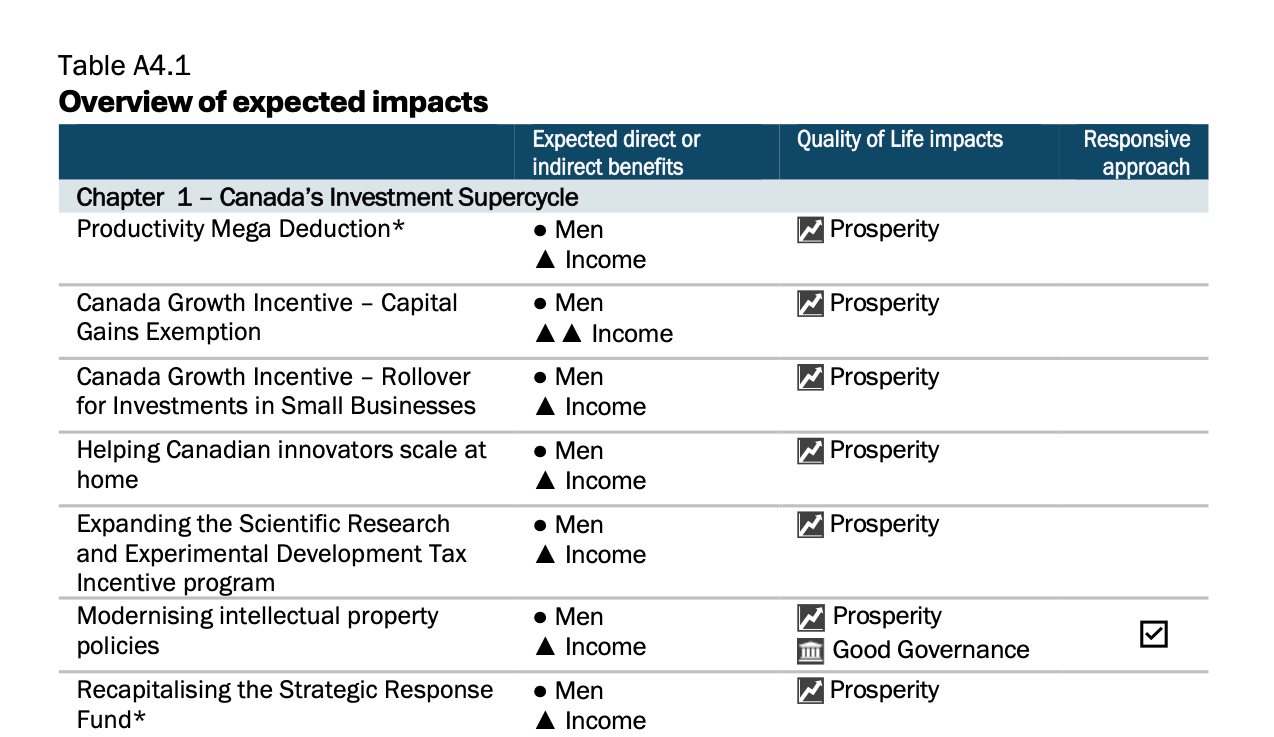
Second…there’s a lot of gender here. The first seven entries in the summary table analyzing the budget—the big corporate and investment stuff—are all focused on men and income. The additional icons point to predominance, so the first entry is means that the gender group to be impacted the most is “majority men (60% - 79%)” and the income group to benefit the most is “Majority high-income people (somewhat regressive)”. The second entry’s income category is “Predominantly high-income people (strongly regressive).”
Looking at the government’s own GBA Plus analysis, it’s clear that while there are important parts of the budget that will lead to positive changes for those who are struggling—like childcare funding—major parts of this budget are targeted at high-income men.
I’ve been very kindly given a thousand words on the 2026 Budget, but to nod at the glaring omission here, there’s a lot about how the Carney government is making immigration policy—not just the spending allocated to the CBSA and the IRCC, but also the lack of real changes to the Temporary Foreign Worker program (the one described as modern slavery, yes), and the real human rights concerns in the updated Levels Plan—but that’s for another time.
Conclusions
We have tried to hit all the major top lines of the budget in this ridiculously large article. I’ve just been so unimpressed by the coverage of this. Journalists are under so much pressure to get their byline out that they don’t have time to have a deep reflection on the good and bad of the budget. I don’t think the actual numbers in the budget will be as important to normal people as the overall trajectory, so my goal in this was to present that to you.
There is both good and bad in the budget– it’s much better than last year, but it’s still a corporate welfare state that we’re digging into. There are some positive things about affordability, but things like pharmacare have been abandoned and childcare needs a boost. Still, there is some solid support to keep children out of poverty and good investments in culture.
But in the end, the single largest item here is their tax cut for corporations who invest in the country. It is trickle down economics, which we already know doesn’t work. I have not addressed the housing plan because I have a full 2000 word article coming out with the Walrus about that, which I hope will be out in the next two weeks or so– I’ll update you all when it’s out. This budget is more of the same as what we’ve seen for the past thirty years, which isn’t all bad. We have some social democratic elements to our society. Mostly it’s dominated by the neoliberal elements.
It’s the corporations who are the biggest winners in this.



Join the conversation