The Alberta referendum: extremist grievances made manifest - The Loop
This isn't a separation movement. This is a movement to join Donald Trump's United States, and is nothing more than the continuation of the far right movements of the past decade

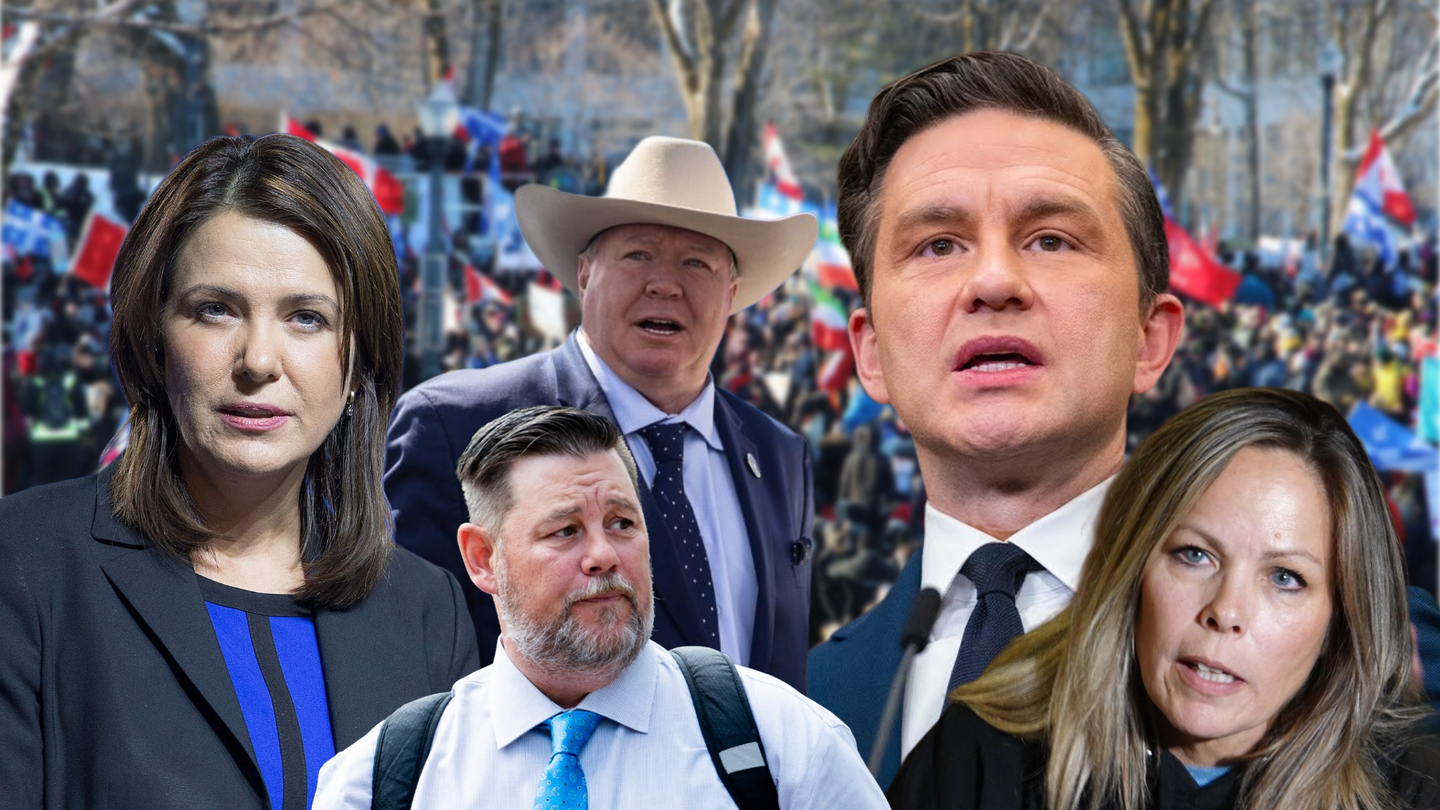
The Alberta secessionist movement is the logical next step in the grass roots movement that started with the People’s Party of Canada, the Freedom Convoy, and Pierre Poilievre. The secessionists don’t want to craft a new, sovereign Alberta, they want to join Donald Trump’s America. To understand this movement, we must go through its recent history.
Welcome to a special edition of The Loop for October 17th. Instead of breaking down the daily news this week (there wasn’t anything too notable, it was a slower news week), we present to you the timeline of Alberta’s referendum, and a full contextualization of it as the successor to the freedom convoy. For those who are new to On the Trail, we frequently do historical contextualization of modern events. Here's one on the Parti Quebecois. Here's one on the Winnipeg general strike. Here's one on Stephen Harper. There will be more. Many, many more. In this house, we love historical journalism!
Press Progress did a profile of the major players in the referendum on October 15, so I highly recommend you check that out for more of a personality breakdown of what's happening in Alberta. This is more of an historical article.
To really understand the flaws in this movement, we must look through the lens of Quebec. As usual, Quebec did it first. We’ve been here the longest, and we’ve tried the most stuff, and we’re the most volatile province in the country. Modern Alberta notwithstanding.
Crazy racism? Quebec did it first.
Religious fervour? Quebec did it first.
Referendum on separation? Twice, babeeeey!
While I was travelling through the country this summer alongside my dear friend, Blue Jay Walker, our stop over in Alberta was chaotic with tons of people angrily yelling at us for one reason or another. The one time that I was clipped by a car was in Alberta. The two times a car chased me down in the road was Alberta. We produced this (now very famous) video. On Instagram it has more than a thousand comments, many of which are simply “lgtv? I have a Samsung” or some variation of that. In fact, some people who recognize me on the street simply yell “LGTV” with no context and don’t even speak to me.
I love it. If you ever see me on the street, do exactly that. Shout as loud as you possibly can: “ISAAC PELTZ! LGTV” and I will laugh.
What we discovered in Alberta was that people were an emotional wreck. But I’m a student of history, and there’s a province who’s been through this already.
How to build a credible sovereignty movement
In 1995, the referendum destroyed family and friends, and ripped the nation apart. That’s just what happens with referenda on separation. People become cutthroat. It exposes deep canyons in people’s worldviews. It calls into question something about someone’s identity, and people might feel dismissed, unheard, like they’re being patronized or that their opinion doesn’t matter.
It’s such an emotional topic because people feel Canadian. Or maybe they feel Quebecois. Maybe they even feel Albertan. It has nothing to do with reason or logic. But the Alberta separation movement lacks something that Quebec separatism has: culture and an intellectual framework for separating. This isn’t to say that people in Alberta have no culture or that they don’t have intellectuals, they have both. But it hasn’t been developed in part around the idea of creating a sovereign nation.
Take literature. Name to me what “Albertan literature” is. I’m not talking about Albertan authors who would be called Canadian authors. I mean a culturally specific literature that is recognized in other countries.
In Quebec, our literature is studied in other countries. There are schools devoted to studying Gabrielle Roy. Or Louis Hamelin. Or Hubert Aquin. In Francophone countries, there are classes devoted to studying our texts in the same way we would study French or Martinique literature.
Where is “Albertan music”? And I don’t mean artists who are from Alberta, of which there are plenty. I mean this. Or this. Here’s a phenomenal fifty-minute video about Quebec traditional music by one of the best YouTubers in the world. If you think there is such a thing as “Albertan traditional music,” I’ve got bad news. Jason Kenney, the previous premier of Alberta, tried to change the school curriculum to teach kids about his grandfather's band. It didn't work out.
That’s the cultural side. Then we have Marxist intellectuals like Pierre Vallieres, or the great minds behind Quebecois decolonization such as Andre D’Allemagne and Marcel Chaput. We have thousands of thinkers who have come and gone. The FLQ and their communist manifesto, which, by the way, is super interesting to read. You have successful parties in the National Assembly with what is generally agreed to be the greatest government ever elected, being that of the PQ in 1976. Who held the first referendum. Separatism was a left-wing republican movement as well, always with an anti-colonial mindset.
In complete opposition to a long cultural development of separatism is Alberta’s movement.
We encourage everyone to support us! We have tiers as low as $3 a month that allow you to see every article and access the full database. $3 a month isn't even a coffee. If everyone supported us with that much, we would be able to hire two more journalists full time. Imagine if it wasn't just me and Aedan. Wow!
It's a takeover, man
Alberta has always had separatists spurred on by a very real phenomenon called “western alienation, which is a problem grounded in truth that western provinces aren’t properly represented in Ottawa, which is dominated by Ontario and Quebec interests. We can all understand why they think that– it’s because it’s true. But beyond this grievance, which could be easily fixed by changing our electoral system to be proportional, there has never been a cohesive ideology behind western separatism. Quebec separatism, by the way, has become more similar to Alberta’s. Look at the PQ in 2026, and you’ll understand.
Still, Quebec separatists can talk shop and discuss ideology, even in 2026. In Alberta, it was really hard to find a single separatist who wouldn’t, within minutes, start complaining about Indians. One interaction that we got on camera was an immigrant couple from Britain complaining about immigrants taking their social systems. It was like a badly written scene in a movie. Honestly, my mouth was agape afterwards. I couldn’t believe that this was reality. “It’s a takeover, man,” the British dude said.
Okay bro, but you realize you’re one of “them,” right???
He did not.
The freedom convoy
I think it’s important to mention the trucker convoy in this discussion. This is the logical continuation of that far-right grassroots movement. Tamara Lich, one of the leaders of the trucker convoy, was a hard separatist. She was one of the leaders in “Wexit,” an extremist Albertan movement looking to separate. Her co-leader of the convoy, Pat King, is another Wexit leader, and is a far-right extremist. Along with her at the trucker convoy movement was the support of the extremist group Diagolon, which wants to deport all Indians.
Prior to this convoy, the PPC had been taking up much of the far-right vote in Canada. They had been eating into the support of the CPC, and that opened up the door to someone like Pierre Poilievre being elected as the party’s leader. They needed to shore up the far-right vote in order to take power back from the Liberals, and so after ousting Erin O’Toole because he wouldn’t take a stance on vaccine mandates (and a few other things), the party overwhelmingly elected Pierre Poilievre. More than 300,000 individuals signed up to be Conservative members to vote for him, 300,000 people who were online activist types that wanted nothing more than to get someone into leadership who would focus on their needs– that of the isolated, online white man.
Poilievre allied himself overtly with the far right, even meeting with the extremists at Diagolon. He supported the truckers openly, and wanted to bring their beliefs to the Parliament as Canada’s next prime minister.
He didn’t. Instead, Mark Carney won with a centrist platform that left behind much of the identity politics of the Donald Trump era. Today, the Conservatives are collapsing in public support, with many polls putting them at below 30 percent nationally. Canadians don’t mind a moderate conservative in power– otherwise how would Chretien, Harper and Carney have won? It seems Canadians, with the exception of Alberta, are reluctant to embrace the far right, like many European countries and the United States.
The western (Albertan) extremists were incensed over another loss to the Liberals. But Trudeau was gone. They had gained so much force in the mainstream because they targeted a national figure; they had a symbol of everything that had gone wrong with our country. Without him, they were listless, not sure what to do. Thus, separatism became their renewed focus. They are numerous in the UCP, and they want this to happen.
So here’s what happened.
THIS TIMELINE MIGHT NOT WORK PROPERLY IN YOUR EMAIL. CLICK HERE TO OPEN IT.
Let's join the USA
The motivation is clear. Leave Canada to join Trump’s America. And the Americans are doing their best to make it happen. The Heritage Foundation, who are the masterminds of Project 2025, AKA Donald Trump’s election playbook, acknowledge bluntly that Alberta wants to join the States. Russia is pushing for separation to happen.
The separatists don’t want Albertan sovereignty. They’re trying to become the 51st state.
People are extremely emotional. Elections Alberta thinks participation will be around 80%, maybe a bit more. That would be exceptional, considering that election turnout is usually around 40 percent. Generally, Alberta is a highly disconnected province, and doesn’t display a deep interest in democracy. In the previous referendum, 38 percent voted. If more than 80 percent turn up for this vote, it would teach us something. If the usual suspects show up, it teaches us something else. Separating from Canada is less likely the more people who show up to vote. In this case, the separatists are going to show up no matter what. They’re much more passionate about this issue than federalists. By the way, everyone is allowed three hours’ time off on Monday to go vote, just like a normal election.
Mark Carney officially declared war on the movement this week. "Say no to the nine," he said off the cuff. Danielle Smith was extremely upset minutes later, posting about it on her instagram. This might mark the end of the easy working relationship of Carney and Smith, as he explicitly opposes her anti immigrant, anti federal agenda.
What to watch for next
What happens after Monday, though? It’s likely just the beginning of this fight. The most interesting thing to watch isn’t what happens with the referendum– it’s going to fail. What’s more interesting is how badly does the referendum fail. We might discover that a majority of UCP voters are separatists. Next month is the UCP AGM. If a majority of UCP are separatists, it could spell the end of Danielle Smith. What happens if the UCP becomes a full-blown separatist party?
Most likely we get the return of two right-wing parties in Alberta. For the vast majority of Alberta’s existence, it has been run by right-wing parties, with almost half of the twentieth century being progressive conservatives. The Wild Rose Party was another right-wing populist party (Danielle Smith’s previous party) and it seems that the makeup of the UCP is more Wild Rose than it is PC. That makes sense, seeing as the leader is a hard-right populist.
The moderates are still in the party, though. If Danielle Smith was forced out and a separatist was put into power, the party would struggle to remain together. Federalists are flocking to the NDP, but a split in the conservative vote would once again make the numbers in the province harder to predict.
So, attache ta tuque, because things are just getting started in Alberta.

Join the conversation