Is democratic socialism innately racist?
Correlation isn't causation, but like, why are all these democratic socialist places kinda racist?


The first half of this article came out on tuesday. Please go read it! Two halves of a whole. This article is free for everyone.
Deconstructing socialism
Can democratic socialism exist without racism?
Genuinely, I'm asking that question. Why are social democratic states so often racist? If you haven't read part one of this two part article, please check it out.
My experience biking through Quebec had gone from being the best experience ever, to making me suddenly question a lot of my assumptions about my existence in the province. Sometimes your privilege will sneak up and beat you in the face.
Well, I guess it's as good a time as ever to deconstruct Quebec racism and socialism's weird marriage to racism.
Quebec is at the center of socialism in North America. It was a natural outpouring of a working class society who was underprivileged and unrepresented in its own country. For decades, it was assumed and accepted that the political class would steal from public funds-- during Duplessis' reign, ministers and public office holders would siphon 15 percent off the top, Pierre Godin explains in his biography of Rene Levesque.
Out of oppression, a people's movement was born. The sixties came with a wind of renewal, and the Quiet Revolution was born. If you haven't read my history of the Parti Quebecois, I encourage you to do so.
But during this social revolution, Levesque fought endlessly to hold back the worst impulses of Quebec. In the province, there remains an instinct to have a bit of an ethno nationalism. Levesque wanted to believe in the Quebec nation as a people, but without violence and without racism. He was one of the first Quebec ministers to try and make life better for the indigenous in the north, and although the man has a great many problems, and although his approach wasn't perfect (maybe it wasn't even good), the goal of Quebec's 60s-70s nationalism was to create a nation based on ideals and principles. Today, that's gone.
Abandoning principles
As we discussed in the history of the PQ, one moment stands out as a left turn for Quebec's social democracy. In 1995 the referendum on separation failed by half a percentage point. “It’s true that we were beaten– but fundamentally by what?” Parizeau yelled out to an angry, dissatisfied crowd on Oct 30, 1995. “By money and the ethnic vote.” The premier blamed indigenous people and immigrants for the failure of his referendum. I never met him before he died. I would have asked him if he was speaking out of emotion, or if he truly believed that.
After the '95 referendum, separatists were emotionally distraught, and fair enough, they believed in a future with a sovereign nation. The province has gone down a dark path since then, reflecting our older brother in France with our treatment of Muslim people in particular.
But this type of racism is par for the course in social democratic places. Since Bouchard's government, there has been an obvious shift to the right, sometimes dramatically so. Bouchard himself was a Progressive Conservative with Brian Mulroney, and after this came Jean Charest, also a PC MP. Quebec had changed. Still, remnants of these old views remained, and Quebec manages to be a unique place nonetheless. Charest theorized that the best way to counteract the failings of Harper's extremely conservative federal government were to compensate with taxes in Quebec. These taxes were regressive taxes, and mainly tax the working class as opposed to high earners.
The tendency away from Quebec's idealized social democracy of the late 20th century came with the racism. Levesque had spent his career holding back the worst impulses of the PQ and of Quebecers in general, but suddenly, after Parizeau's speech after the '95 referendum, it was mask off. Islamophobia was exacerbated by the 9/11 attacks, which the Harper government used to further his anti-democratic, christian nationalist agenda. In Quebec, anti-muslim movement formed, and Harper's infamous Barbaric Practices Hotline came off its heels.
In 2017, this Islamophobia reached an apex with a shooting in a mosque. Since then, Muslim women have continually been targeted as scapegoats in Quebec, with a recent law passing in Quebec that bans public prayers, and even bans prayer rooms in universities. This approach to banning any religious symbolism was an expansion of traditional secularism, which used to be the separation of church and state, but is now recognized as "seeking to remove religion from any public sphere."
Definitions change, and Quebec's secularism is not the secularism of your grandpa.
Europe
France has a similar trajectory, although it goes on even longer than Quebec's. Scholars have criticised the anti-hijab movement as a continuation of France's colonial history, and a way to demonize North African Countries. Quebec often follows suit when France does something. France, a social democratic nation, has historically had one of the most robust and exceptional social welfare systems in the world. High taxation and a culture of militant unions has created an exceptional welfare state, although the country does not tax high enough for it to continue without problems in the future. France's welfare spending is second only to Finland. France has a severe problem with racism, as 9 in 10 black people in the country are subject to racist discrimination. Meanwhile, the Front Nationale (Rassemblement Nationale now, but I will call it the Front Nationale because they're literally a fascist party, and the RN is the same party. They're actual, open fascists, which is different than Republicans in the States, who are closeted fascists.) is a white supremacist party who looks poised to win the next presidential election off of a racist platform.
Looking at the Nordic countries, I hardly need to detail the severe xenophobia and racism coming out of Sweden. Quite literally, the former neo-nazis are the kingmakers in their parliament. Elections will be held in Sweden this September, with the social democratic party in the front, but the right wing parties may have a combined seat count to continue ruling.
In Norway, hate crimes are rapidly on the rise, as you can see in the chart below.
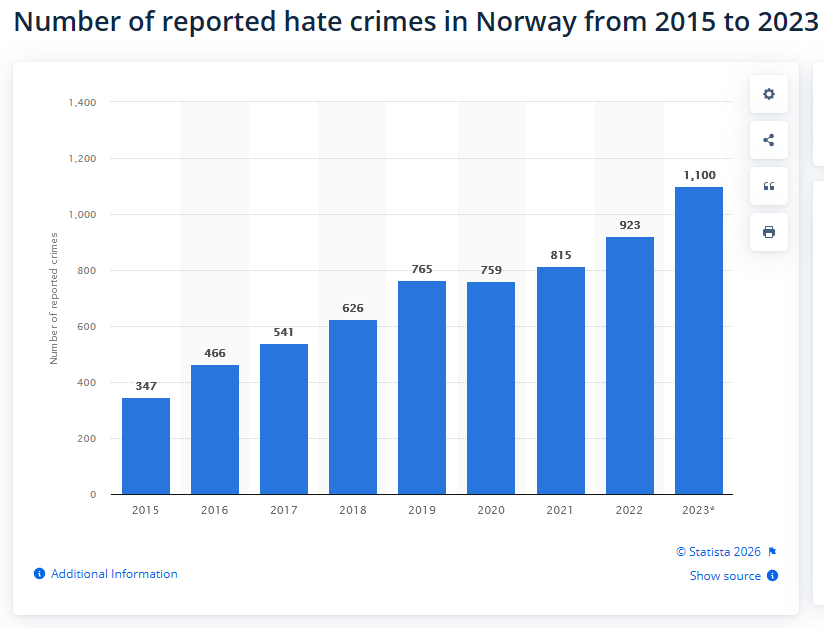
In fact, the Nordic states are some of the most racist democracies in the world, leaving poor Americans in their dust, no matter how much the United States continues attempting to win that award.
"Based on the study made in 2018, 63 percent of people of African descent in Finland have experienced racially motivated harassment, compared to a group average of 30 percent in the 12 European Union states surveyed. In both Denmark and Sweden, the number was 41 percent," Harvard politics writes. Wow, that's dismal.
Correlation isn't causation
There seems to be a correlation between social democracy and racism. It's obviously not a given, but the question we must ask ourselves is how we can have both a social democratic nation while simultaneously not being racist.
I don't have answers, sadly. I wish I could give you answers. We're faced with a major problem around this as well: In France and the Nordic countries, their electoral systems hold back their worst impulses. They have proportional representation, so when the two nationalist right wing parties come together to rule, they still have a minority. If the Front Nationale wins, it's highly likely that they'll be in a hung parliament (where elected officials refuse to work together.) In Quebec, if the PQ wins, they're extremely likely to win a majority. In fact, they can win a giant majority with only 36 percent of the vote. I encourage everyone to look at my article on the Walrus about proportional representation.
The CAQ won more than 80 seats with 40 percent of the vote, a shocking, and frankly disgusting, distortion of democracy. In Quebec, if we elect the nationalist xenophobic government, they can do pretty much whatever they want. And they can ignore human rights as well, since our constitution has a giant gaping hole in the middle of the thing called the notwithstanding clause.
Whether or not socialism or social democracy is truly linked with racism, I don't know. It seems like it might be, but correlation is not causation. All we can do is study trends and ask questions. This article doesn't have answers, only questions and stats. That's sort of a pattern in most of my articles. I ask a lot of questions. I rarely answer them. But in the end, answers are only valuable if they have an actionable response as well.
So, I suppose finding a way to change is the next step.



Join the conversation