

Thunk, thunk, thunk.
Whenever you get woken up by the police, they hit your window as hard as they can.
Every time, Jay would jump up, and scramble to get clothes on. I was sleeping on the floor on a little blow up mattress that my mum bought me. Jay mumbled curses under his breath as he put on clothes.
"Cops always persecuting me for living my life," he would grumble. This was about a week after we escaped Tofino, where the police had hunted us for three days and nights for being homeless in the town.
Jay opened the side door of the van. I remained silent, laying on my mess of a bed, wishing that I wasn't about to get moved along. It was almost 11pm.
"You can't sleep here," the policeman told Jay and I. About three weeks ago, we could.
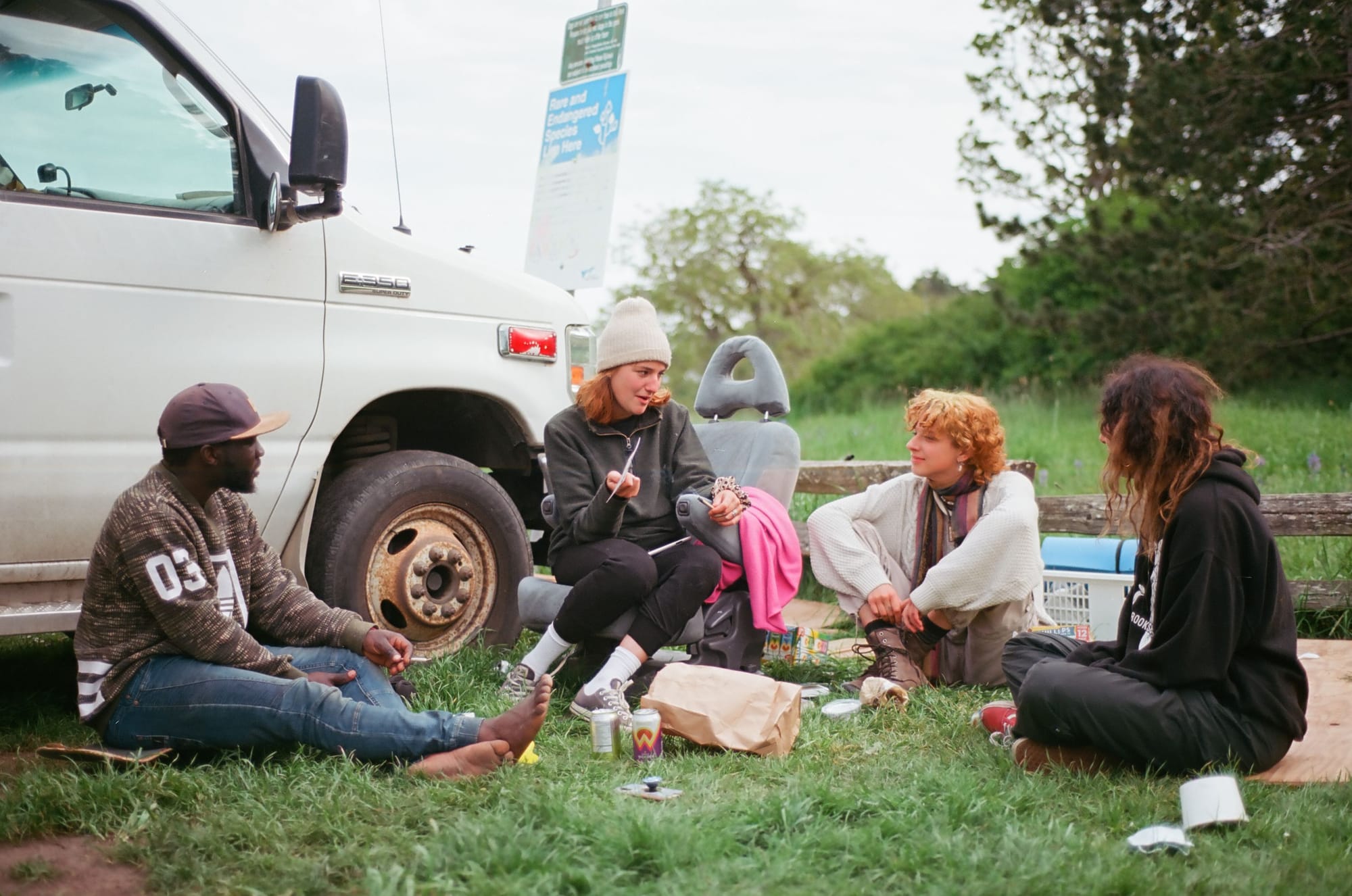
We were in Beacon Hill park alongside a small army of homeless folks. Before today, there were the vans in the parking lot (which we were a part of) and there were the tents in the grass.
There had even become small suburbs within the homeless encampment. We lived in what we called the Francophone Bloc, where an army of Quebecers and French people had parked their vans. They were musicians, artists; esoteric hippie types. The Anglophone Bloc was British Columbians who had escaped the endless policing of Vancouver and come to the island for a little peace while they waited out the pandemic. The tenters, well, they were homeless folks with tents.
When we'd arrived, the park had been sanctioned as a place where the homeless could live, undisturbed by the police. As long as they kept relatively clean, there would be no problems. The city had quickly created a space for homeless people to live when lockdown started.
Jay and I showed up in January, and would roam around daily. We made friends with much of the community there. A few of the Francophones I still see around Montreal sometimes-- playing accordion over in Parc Lafontaine, showing up to shows around town. Some of them were too constantly high to retain any memories of my existence, but I remember them.
My tenting friends, well, I don't know where they are. Vagrants aren't famous for keeping in touch.
Jay and I had gone on a three week trip to the mountains to film part of a documentary, but before we left there were rumblings of a police crackdown.
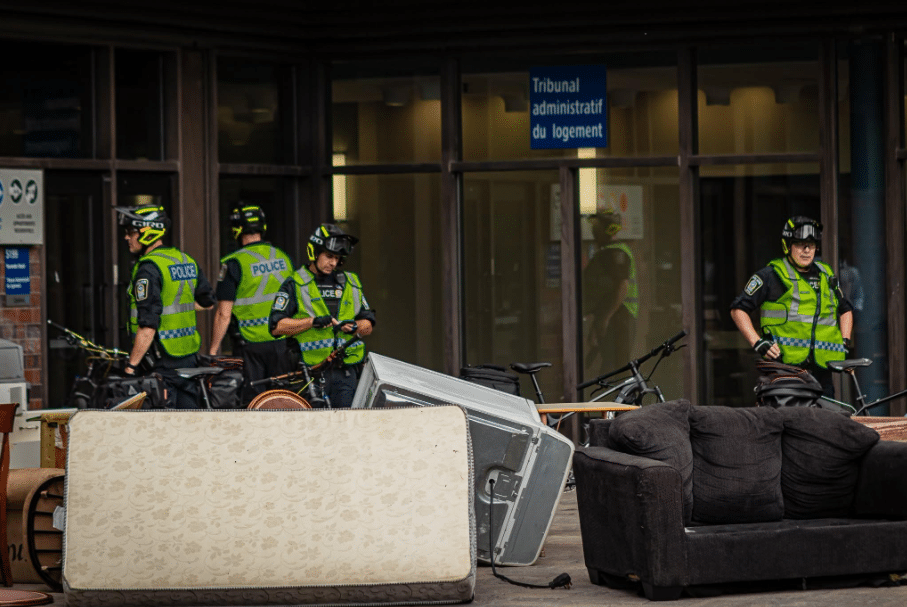
"Any day now, the police are gonna arrive and throw us out," my neighbour said to me one day. Already they'd started aggressing some of the homeless folk for spreading their tent a bit too far. Mayor Lisa Helps was preparing to reopen the city to tourism.
Jay and I left for about three weeks, and we got back the day before bylaw destroyed everything. As the policeman kicked us out of our spot that night, we knew that the end would come in the morning. And it did. There was nothing left behind but yellow squares on the grass where the tents used to be.
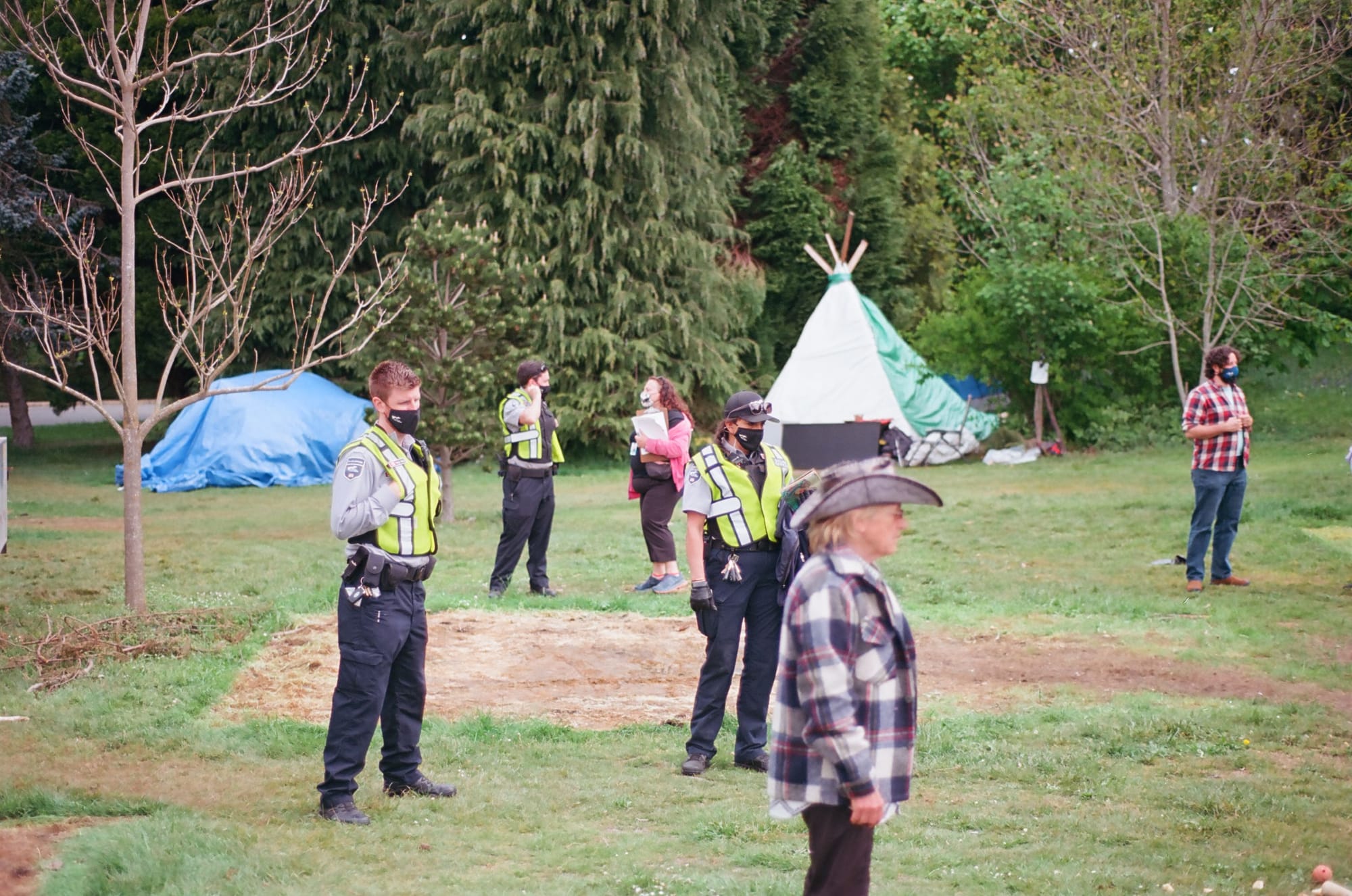
This was the first time we saw it happen, but not the last. Soon it would happen in East Hastings, and Slocan in Vancouver. Then Trinity Bellwoods in Toronto, and eventually out east.
There was a big advantage to Beacon Hill park becoming a centralized location for all the homeless. It was ugly, that's for sure– it smelt like piss a lot of the time, and there were a fair few nights where someone would be screaming about wanting to kill someone or whatever, but overall it was peacable.
Because everything was so centralized, the city and province could pour their resources into one centralized location. There were two days a week that breakfast was handed out to the locals, two days a week where the Salvation Army would bring portable showers and everyone could clean up, there were medical tents, and clothing tents, there were park washrooms that were usable. In fact, deaths remained exceptionally low because there was always someone close by with naloxone.
This week, a new report came out that Quebec is spending $95,284 per unhoused person per year, versus $5,900 for everyone else. It's 16 times more expensive if someone is on the streets. The cost of living crisis is exceptionally expensive. It would cost significantly less to hand out money to people and house them with the state footing the whole bill.
The same report shows that if the state was to fund transition housing which would help with recovery and living expenses, it would cost them only $48,780 per person, or half the amount that they're spending right now. It would cost a lot less money to fund treatment centers and get people off the street. But the government is perplexed at the complexities of mental health, and how challenging it is to rehabilitate people, even though it would save them huge swathes of money every year.
These numbers were specifically given for Quebec, but I can promise that they look similar in other provinces.
Meanwhile, the government seems proud that inflation remains at 3 percent. The problem with this measurement is that it's calculated by averaging all industries-- it's accounting for housing prices, but it's also accounting for job losses. Thus, in some sectors there's no inflation, or even deflation, but other sectors are bringing up the average. Mostly the average is being brought up by sectors that normal people struggle with, such as groceries and housing, while the job market remains tough.
But that's just the tip of the hat for the news.
EXTREMISTS WIN BIG IN GERMANY
The far right has won a state government in Germany. In other states, they're leading as well- although social democrats are not far behind. The AFD (Alternative for Germany) wants to heavily restrict immigration, restore ties with Russia, quit the euro and promote German ethno-nationalism. It is a return to extremist neo-nazi governance that hasn't been seen since World War II. I have a lot of questions about how this will play out, personally
Democracies are more robust than they were nearly a hundred years ago, with better systems and more protections. It's been hard for Donald Trump to completely transform the United States, the country remains a democracy despite losing it's liberalism. That being said, I don't know what will happen in the midterms, but I suspect it might be tough for the Republicans to overthrow democratic systems. That being said, I might eat these words.
Back in Germany, the AFD wants to persecute immigrants, and are neo-nazis, though they deny the label. Germany is in for a rough ride. But examples like Sweden and America make me think that it might not be the end of democracy in Germany. That being said, democratic regimes can just collapse sometimes. The AFD wants to leave the EU, which would probably end the whole thing.
Can democracy hold out against the advance of fascists worldwide? France's elections in 2027 are not going to be fun for anyone. Across Europe, fascism is back. In Canada, the far right is mainstream, and every centrist, or centre left party has moved to the right. Just look at the BCNDP or the Federal Liberals. Leftism in Canada virtually doesn't exist, not in any practical sense. So what happens now? We'll find out.
Marci Shore noted in one of her lectures recently that democratic systems keep voting in people who want to destroy said democracies. It's the fatal flaw of Liberals (which, if you believe in the rule of law and individual freedoms, you are a liberal in the classic definition. Not talking about the political party), they keep thinking discussions and the "marketplace of ideas" works.
QUEBEC ELECTION REMAINS QUITE DULL
No, seriously. It's tough to cover this election because the three front runners are virtually identical. The question is which flavour of conservative do you want? A flurry of new polling came out the morning I'm writing this newsletter, so here is the summary of the new polls:
Absolutely nothing has changed. Eric Grenier wrote this morning, "The Quebec election campaign continues to sleepily head toward the October 5 voting day." And yes, it does. Check out the three polls here-- but basically the Liberals are up between 1 and 3 percent, and the CAQ is down between 1 and 3 percent. The electorate seems completely disengaged, and how could they not be? The candidates seem more interested in firing shots at one another than proposing a vision for Quebec. Quebec Solidaire continues to be an interesting party with a cohesive vision, but many Montrealers, where the party is strongest, are turned off by their separatist views.
The 5 chefs une election went off pretty well, but no one walked out of it an absolute winner. Honestly, it was long without anything particularly new. Frechette started falling apart at the end, PSPP was raked against the coals about separation, Milliard started weak but ended pretty strong, Ghazal did well until she was pushed on independence, and Duhaime sounded good but wow he wants to return to the 1950s when men like him couldn't live their lives freely.
When Philippe J. Fournier is writing columns like this, you better believe it's a dull election. The options on the table are either uninspiring (CAQ, PQ, Liberal), depressing (PCQ) or struggling to be heard (QS.) This week there are two debates. I will watch them, hoping that there is something new. We still found a lot to say on our French podcast this week though.
ENVIRONMENTAL NEWS
Alberta is looking to nationalize gas pipelines to help power AI data centres. This might be the first time nationalization is being used to help private corporations as opposed to the public.
AI might literally cause a mass extinction within the next ten years, and AI companies don't care.
Canada kept importing Russian oil into 2026. There's some sort of deep irony here.
Super El Nino means winter might take a holiday in Canada.
Quebecers want big polluters to pay.
The Liberals released a major climate report. They didn't tell anyone. They're under fire for it, as Julie Dabrusin remains almost nonexistant on the federal stage.
Gypsum recycling program announced in Quebec.
New power lines break ground in BC despite lingering questions.
Feds exempt oilsand and gas power plants from environmental impact assessments.
Wow, that's way too much environmental news. It's like we're making rapid regressions on that front in Canada during a time when things are worse than ever.
OTHER TOP HEADLINES
Vietnamese firm targets Canadians with fake news for profit. This report is fantastic. You should read it.
Manitoba NDP orders striking workers off the picket line and back to work for an American megacorporation. I actually mentioned this Saturday in my article. I called Wab Kinew a "very popular orange Liberal," which I'm certain lost me a few subscribers. But I mean, I'm nicer than some of my fellow leftie journalists about him, so... Go read the piece, it's not actually about Kinew.
It's been 25 years since 9/11.
The Wall Street Journal came out with an article saying Canada is seeking to be an associate member of the EU. Carney responded-- yes there will be work on the relationship, but the article by the WSJ seems spurious. We will see how this pans out. However the EU parliament is opening an Ottawa office.
Donald Trump is promising paycheques of $5000 per person if the Republicans win at the midterms. That would cost $1.3 trillion dollars to the US treasury, by the way. It also probably wouldn't pass congress.
Ukraine and Canada sign 100 year agreement on trade, energy, and defence.
LONG READS
The conservative civil war has only just begun, by the always excellent Max Fawcett. Great read.
If you're bilingual go read this great piece about the PLQ not having a good time.
I know you're worried that I didn't mention the investment summit. But don't worry, I will next week.