Battle Over Montreal Bike Lane Heats Up at Local Council
The borough council voted to proceed with the process to remove a bike lane during the winter without public consultations, locals say.

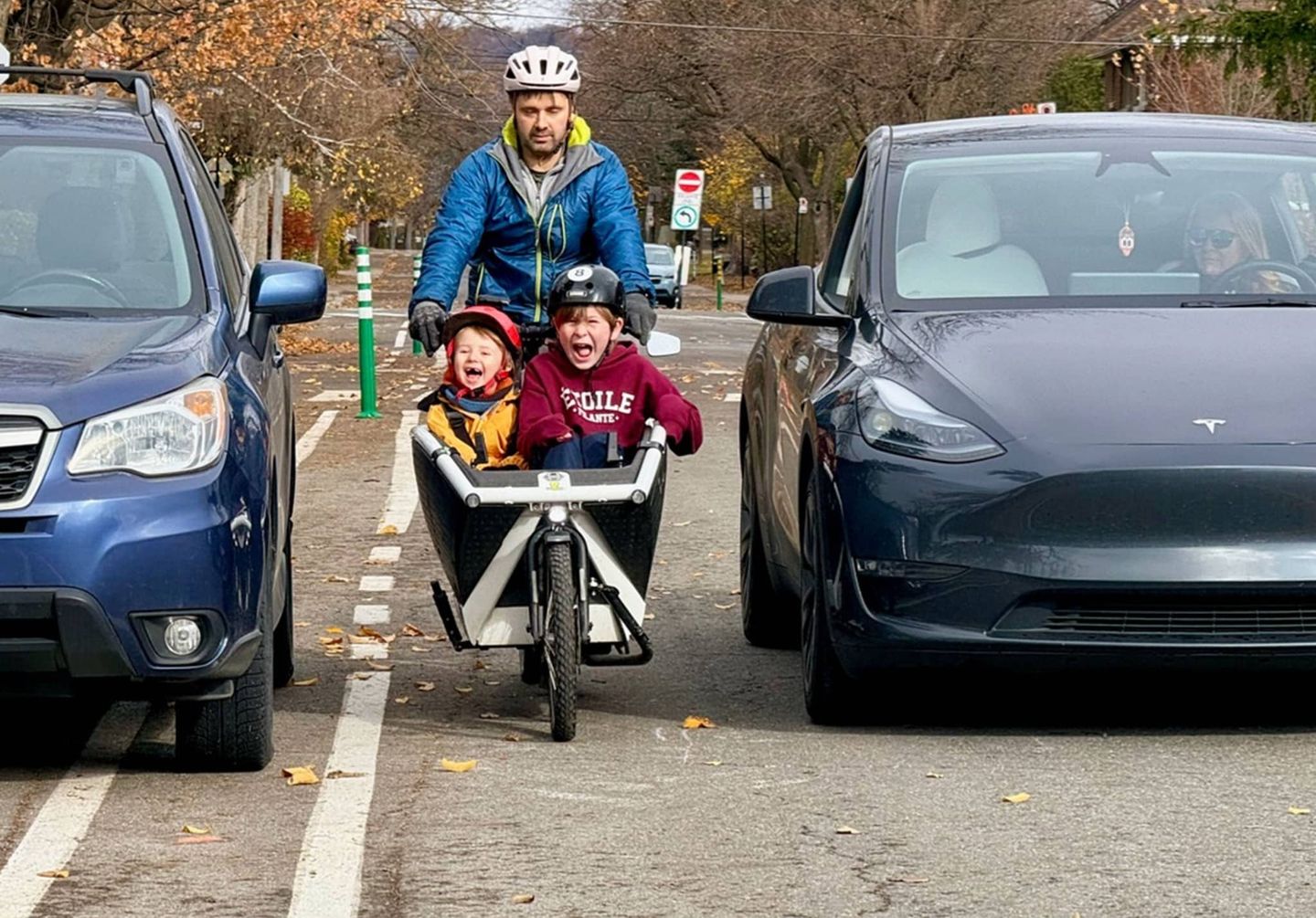
The crowd roared in celebration as they waved their signs in the air.
“Parking safety? Really?” one sign said.
“Stationnement ou sécurité” read another sign.
A chart had been set up in front of the Benny library in Notre-Dame-de-Grâce (NDG), showing data on bike safety and mapping the limited effect bike lanes have on parking and driving — that is, except for alleviating traffic and decreasing collisions.
Families had organized across NDG to attend the borough council meeting on Nov. 2 to protest the removal of the Terrebonne Street bike lane in one direction during the winter.
One resident said his bike was hit by a car on the way to the council meeting. He was biking on a street without a bike lane.
“At the end of the street it becomes narrow, and I'm just going up. I’m going fairly quickly, but the guy was really in a hurry, I think. He starts honking at me,” he said. “So I stop my bike, and I look around, and I'm like, ‘What's going on?’ Then he starts slowly (moving forward). He was upset because I was going too slow for him. Then the guy just drives and then accelerates and hits my front tire.”
The bike wasn’t severely damaged, but he had to disable his front brakes in order to use it.
“What a joke process,” said Peter McQueen, Projet Montréal councillor for NDG. “(Ensemble Montréal) said, ‘We're going to consult. We're going to make changes by talking to the whole community.’”
Locals say they don’t feel like they’ve been consulted, and Patrice Blain, spokesperson for the Association of Pedestrians and Cyclists of NDG (APC-NDG), said that there hasn’t been any consultation at all, and they haven’t received the engineer’s report about the change either.
“This (borough) mayor doesn’t listen to her constituents,” one resident said.
Residents across the borough had shown up to express their frustration and distaste with the decisions of the mayor and Ensemble Montréal. They filled the auditorium inside the library for the council meeting. Three-quarters of the seats were filled, more than usual.
As Councillor McQueen spoke, the audience cheered and clapped.
“What we are voting on tonight… is to let the council do what they want without the support of experts — a completely ridiculous process!” He noted that just the previous week, the preliminary findings of a report on four Montreal bike lanes were released, which found no safety-related issues to warrant their removal. The Terrebonne bike path was not one of the bike lanes studied.
“So leave them! Leave them in place!” he said. Except for a few people who are organizing to remove the bike lane, the audience was behind McQueen.
“I think it’ll be civil,” said Blain before the meeting began.
And it was. But it was tense throughout the night. At the regularly scheduled council meeting, there was a vote on the first step in a process to remove the bike lane. The borough councillors voted to submit the motion to city hall, which would then be voted on downtown, before returning to the hands of the local officials.
The borough mayor, Stephanie Valenzuela, has said that she’s following empirical evidence showing that the bike lanes aren’t being used, particularly in the winter. Alexandre Teodoresco, borough councillor for Loyola, referred to a study during last month’s council meeting that he said showed as few as eight cycle trips in a day during January, although later during the same meeting he said that it was eight per hour during rush hour. He clarified this only after reviewing the data when pressed by a constituent.
Rick Hoge, resident of NDG and researcher at McGill, believes that the councillor had failed to correctly read the data. He believes he was confusing hourly numbers with daily numbers. Screenshots of the study have been posted on the local Facebook group where they’ve been consulted by residents.
“(The numbers) went from 700 to 300 to eight. Obviously, it was never 700 per hour,” said Shannon, a resident of NDG, repeating a phrase Teodoresco had said during the Oct. 6 borough council meeting.
 Isaac Peltz

Hoge says it’s as though the councillor found the lowest number on a slide with raw data, and misrepresented it as being typical of daily winter bike counts — but he doesn’t think it was malicious.
“I would never suggest that anybody is lying. I think we all are subject to cognitive biases,” he said. “There’s an expression that I learned from my PhD supervisor about statistics… to use statistics like a drunk uses a lamppost: for support, not for illumination.”
According to Hoge, the number of bike trips on a typical winter weekday is at least 63 based on the borough’s own counts at one location over the entire winter. In an informal survey recently initiated by the APC-NDG, 87 residents reported biking on Terrebonne last winter. Of these, 28 used the bike lane to take children to school or to daycare. Hoge said that the Terrebonne bike lanes have been used every day over the last few winters.
“They're closing their eyes, or they're looking away to (push through) a political agenda, please their electorates and not listen to the voice (of their constituents),” Blain said.
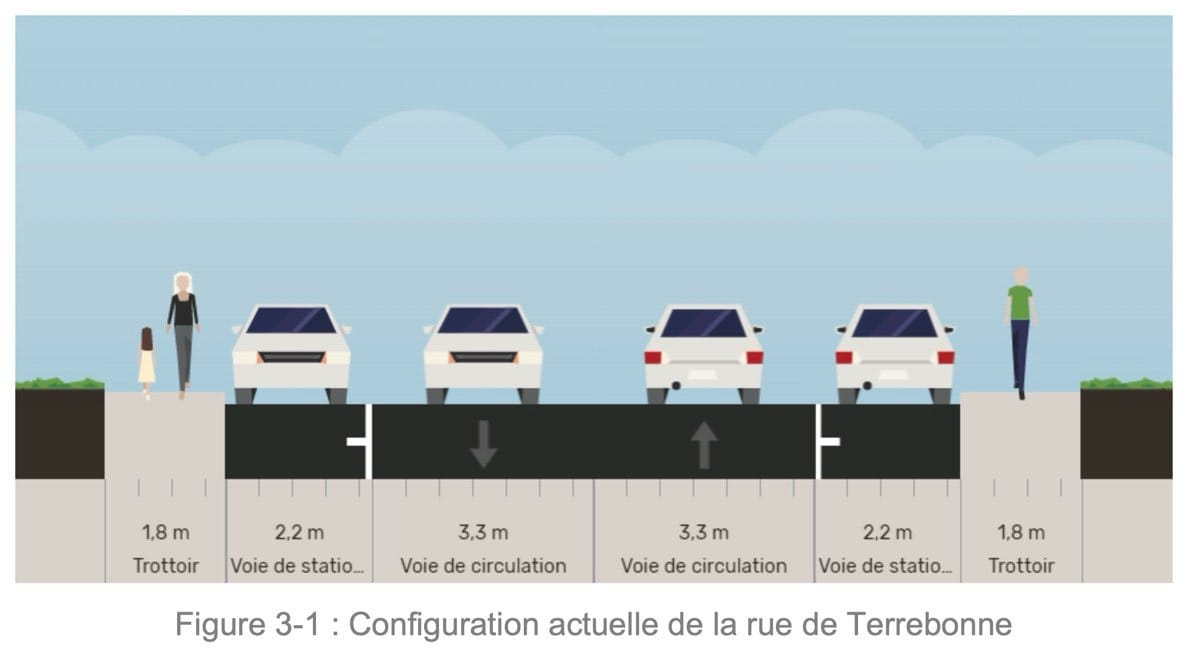
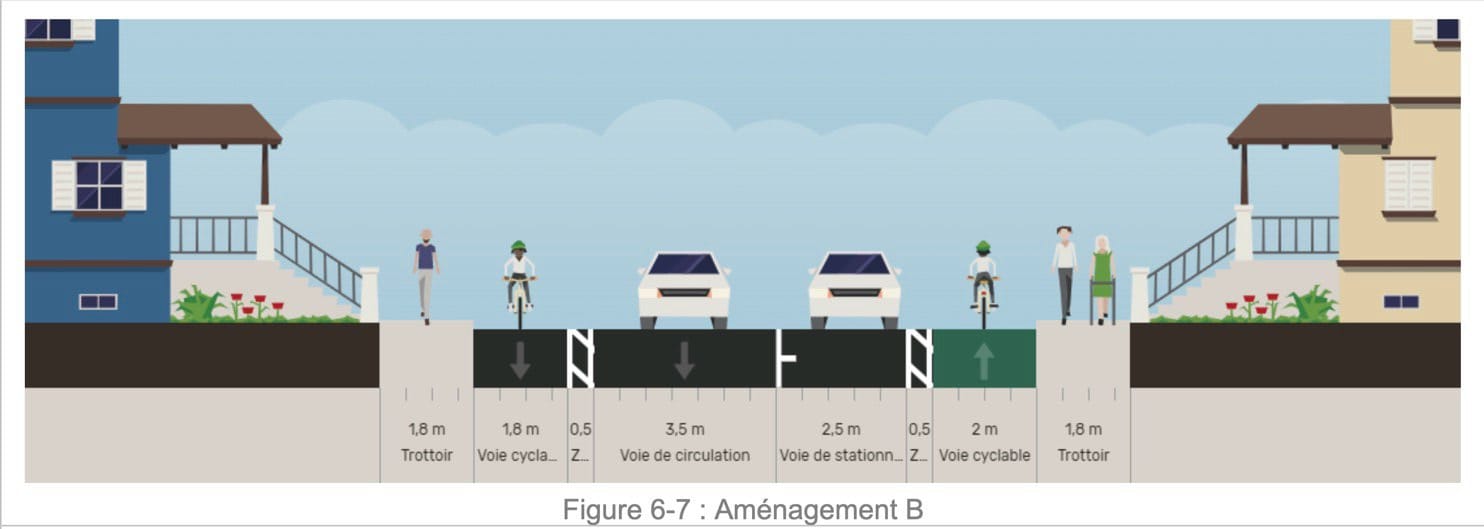
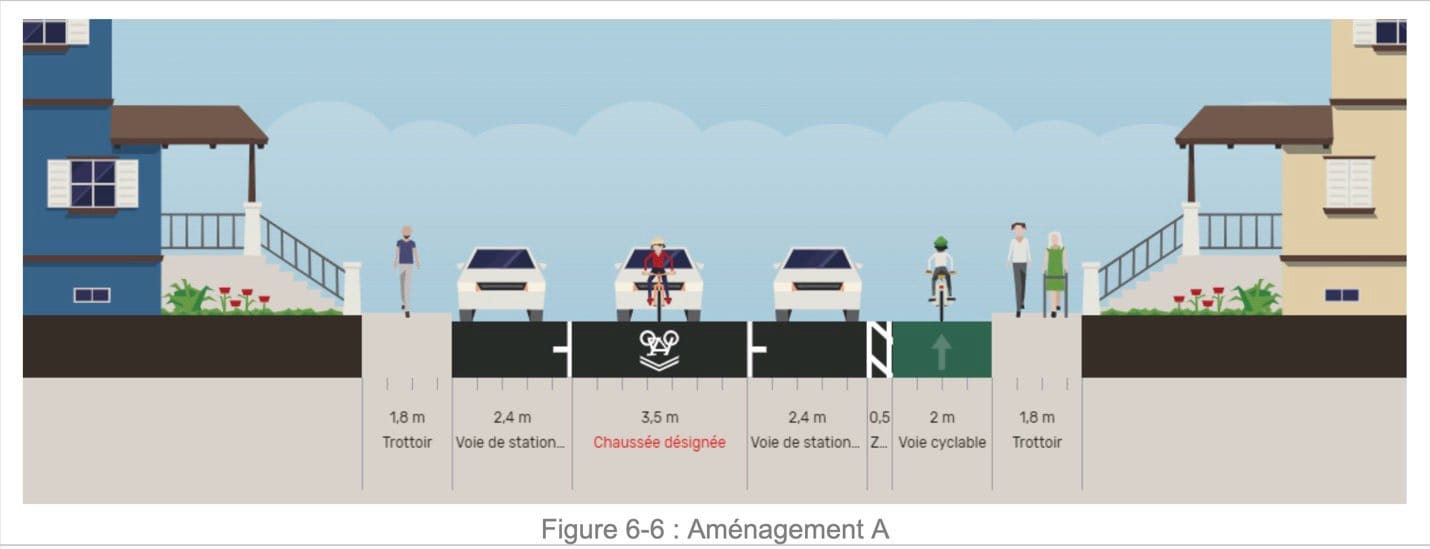
The bike path is on either side of the street and leaves space for parking on one side. The city wants to remove one direction of the bike lane and put the bike path in a shared lane for the winter.
“This is worse than a step back to 2023,” Hoge said, referring to the year before the protected bike path was reinstalled on Terrebonne Street. “And — incredibly — it is reserved for the months when a shared lane is most dangerous.”
Prior to 2023, the road allowed for bi-directional traffic, and there was space to pass bikes on the left and right when there was no oncoming traffic. Under the new proposal, the street will remain unidirectional, but cyclists going with traffic will share the lane with cars, thus making passing significantly harder for cars.
Bike lanes save lives. Research has shown on numerous occasions that they decrease traffic congestion and lower the risk of accidents by calming traffic. People drive slower on streets with bike lanes — which is particularly beneficial on neighbourhood streets with many children. Bike lanes also have an effect called “induced demand.” Build it, and people will use it in greater numbers.
Le Devoir reported that Mayor Soraya Martinez Ferrada wants to put an end to bike lane polarization. She said that she wants to listen to the opinions of “all users of the road” and no longer just cyclists.
Only 2,3 per cent of road space in Montreal is devoted to Bixi stations and bike lanes, though 5 per cent of all trips being taken by bikes. Montreal’s commuting network has worsened in certain sectors during the past 50 years, as The Rover recently reported.
The vote passed to submit the removal to Montreal city hall


Join the conversation