The Notwithstanding Clause; Authoritarian? Or Democratic?
Here is every use of the Notwithstanding clause in Canadian history, as well as the entire context of the debate.

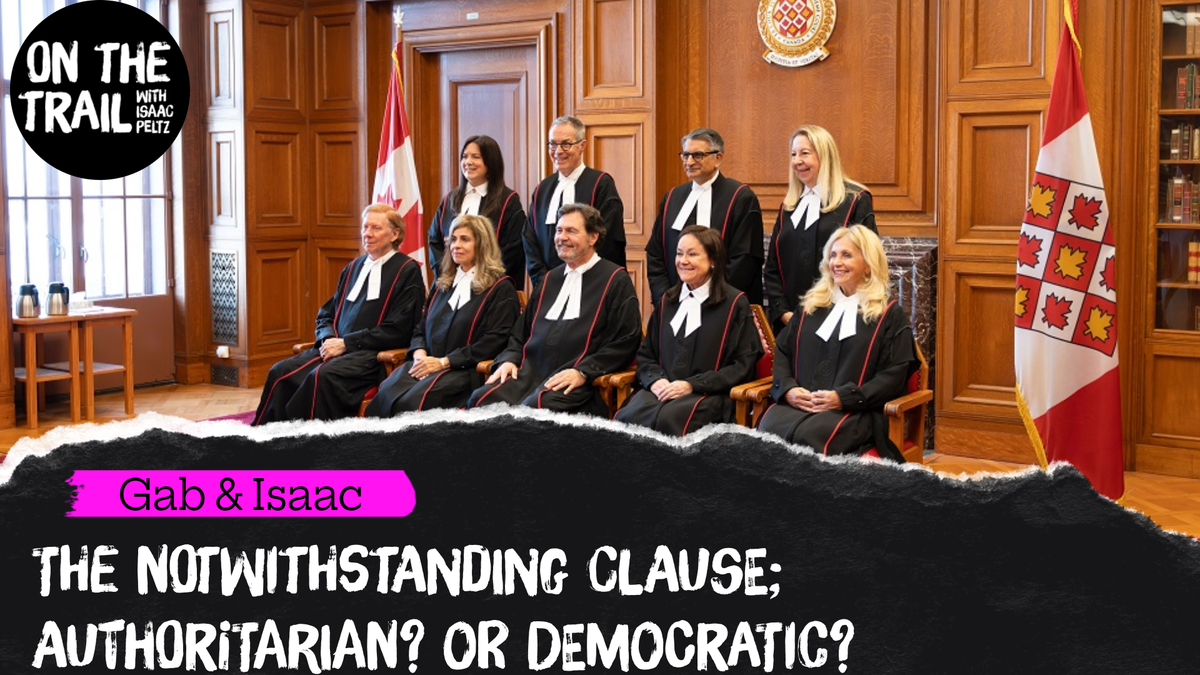
This week, one of the most substantial hearings ever conducted in the supreme court is happening. The question at the heart of it:
Should there be limits on the use of the Notwithstanding clause?
Bill 21, a Quebec law that disallows people from wearing religious symbols in public workspaces, was passed with the Notwithstanding clause. The challenges against this law have been immense, and this week it is being heard by the supreme court.
The court's decision will take time, but this is only the second time in its history that there have been four days of hearings. When their decision comes out, it will set a permanent precedent in Canada, and decide whether there are limits to section 33. I highly recommend this article by the Globe and Mail about the subject.
But what is the notwithstanding clause, and when has it been used?
Here is every use of the clause in Canadian history, as well as a brief descriptor of what happened.
*Note, to see the full chart, open the article on your browser.
Today, many people are angry about the existence of the clause. With the slide towards authoritarian legislation (such as in Ontario, Alberta and Quebec), and the rapid move to the right that Canadians are seeing across the country (both federally and provincially), the concept of the notwithstanding clause seems like it’s a terrible idea.
Most Canadians outside of Quebec didn’t think much about the Notwithstanding clause until the past few years. This is because, as you can see on the chart, it was mostly Quebec that has used it, at least until recently. This is because of the recent misuse that seems common in governments everywhere.
There have always been abuses of this clause, however.
The worst of these was in 1998 by Alberta, when the government wanted to ban people from suing it. For fifty years, Alberta sterilized people, particularly indigenous women, against their consent. When Leilani Muir won a lawsuit against the government for $1 million in damages. The government did not want to take responsibility for its eugenic practices, and tried to stop anyone else from suing them by legislating a $150,000 payout for the hundreds of victims, saying “the bill was needed to protect taxpayers from lawsuits.” The outrage was palpable, and the electorate forced them not to pass the bill.

But the main argument for the existence of the clause was that the greatest accountability measure against it was the electorate. The Sterilization Compensation Act is almost a perfect example of government tyranny facing democratic accountability.
One of the most interesting uses of Section 33, other than Quebec, was the third use of the clause. The federal government– the same government who created the charter– tried to use the clause to execute a serial killer. There’s a deep irony to that. The speaker of the house vetoed the bill citing Parliamentary tradition.
Within a year, the Federal government demonstrated how the clause could be used maliciously. So then, why would a country create something that could be so obviously used by bad actors?
The court case this week has reopened this debate in a spectacular way; the arguments both for and against the clause have merit.
To fully grasp this debate, we must return to 1982 when the Constitution was repatriated, and the cost that Prime Minister Pierre Elliot Trudeau was willing to pay to see it through.