Defending Canadian Sovereignty… By Funding American Billionaires
Under the veil of “Canadian Sovereignty”, Mark Carney’s Liberal government looks to sell off Canadian resources to the highest bidder.

*Updated to correct the name of “Blackstone” from “Blackrock.” I did this in the video as well. I apologize. The name is Blackstone.
One year after the election of Mark Carney and his Liberals as the “new” governing party of Canada, their “Canada Strong” pitch for sovereignty seems to be more of what has come before– sell Canada piecemeal to the highest bidder, usually at the expense of taxpayers and the social systems that millions of Canadians rely on.
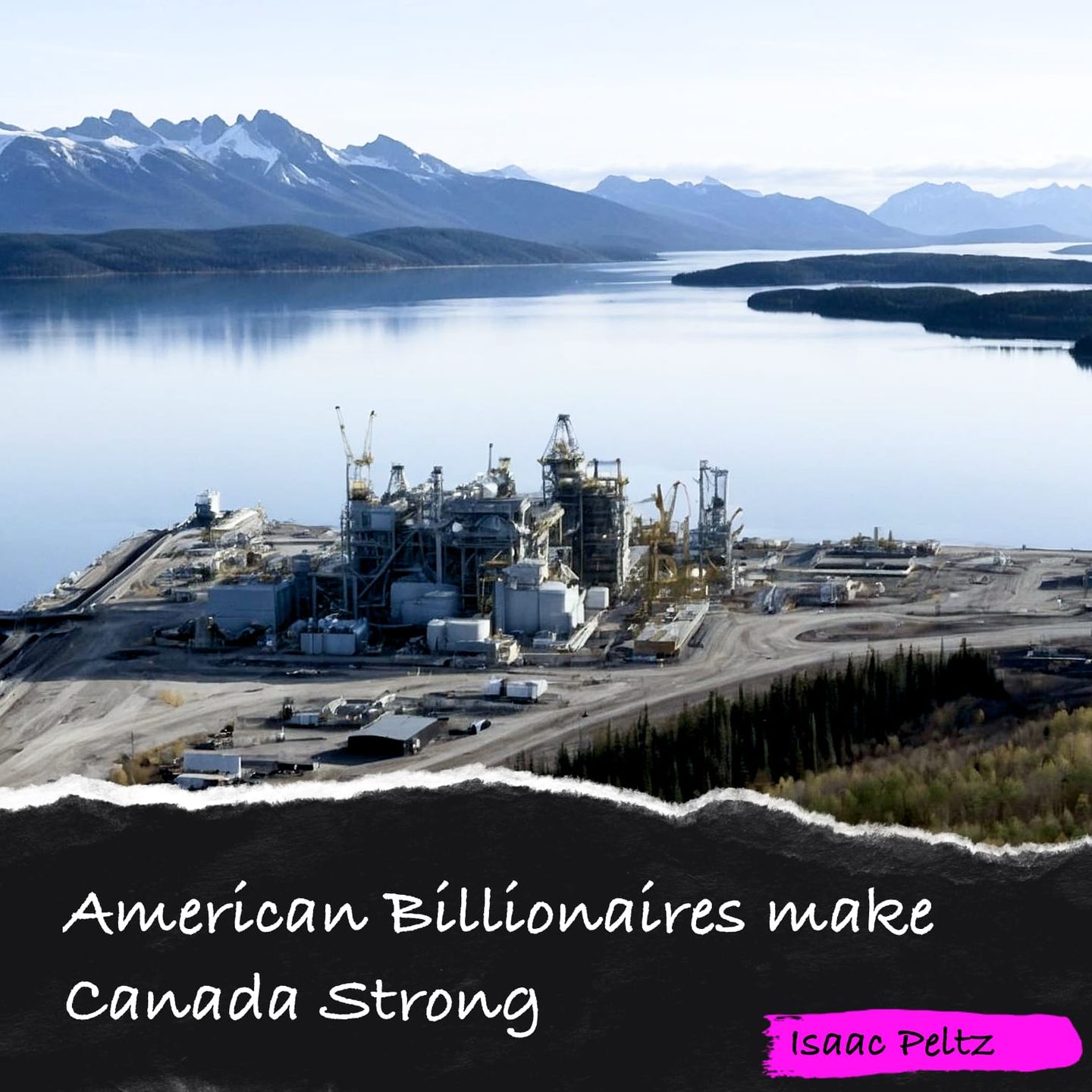
The playbook isn’t anything new. Where Trudeau promised decarbonization while increasing subsidies for major polluters, Carney is selling Canada to the highest bidder under the veil of sovereignty. At the forefront of this faux sovereignty is the Ksi Lisims LNG project.
With Bill C-5, the Building Canada Act, the Liberals have granted themselves the power to bypass regulatory guardrails for any project they deem “in the national interest” through the newly christened Major Projects Office (MPO). One of the first projects they referred to the MPO was the Ksi Lisims LNG terminal, a project financed and backed by American companies.
Gab and Isaac dive deep into the news— including the new sovereign wealth fund!
The Billionaires
Western LNG, a Houston based company, has raised more than $265 million of private investment into the Ksi Lisims LNG project and owns 100 per cent of Ksi Lisims, despite claiming Indigenous ownership. Western LNG is backed by Blackstone and Apollo Global Management, which are led by two American billionaires who drove and profited off of the global 2008 recession: Stephen Schwarzman and Marc Rowan.
Schwarzman is worth ~$43 billion, and is the chairman and co-founder of Blackstone. He is also one of the top ten donors to Donald Trump, and is a longtime adviser to the GOP. He personally contributed $40 million to elect MAGA candidates in 2024.
Rowan is the CEO and Co-Founder of Apollo. Rowan is part of the “Gaza Board of Peace”, a Trump backed initiative to “rebuild Gaza” after the genocide after the US backed Israel to the tune of at least $16 billion.
Meanwhile, despite these American billionaires being big proponents of the pipeline and an American LNG company owning the pipeline, the government projects strength and unwillingness to allow the United States to dictate the terms of the upcoming free trade negotiations.
Tax Breaks
Western’s investments in Ksi Lisims would not go as far if not for significant tax breaks awarded to energy companies by Canadian governments. Billions in dollars are not going to the Canadian and British Columbian treasuries because of these tax breaks. The Canada Infrastructure bank would finance the project under their mandate to work with the MPO. There has not yet been an announcement on how much they might give to Ksi Lisims. They might announce it today in their Spring economic update. We have reached out to Minister of Finance, Francois-Philippe Champagne’s office to speak to him about this. They did not respond.
One of the biggest way the BC and federal governments give support is by providing millions in tax breaks. Those tax breaks include: lower electricity prices, (about half the price of consumer electricity), a two-year exemption from the B.C. carbon tax, a potentially lowered corporate tax rate from 12 per cent to 9 per cent, and a deferral of PST on construction worth up to $21 million– which is basically an interest free loan that will not have to be repaid for more than two decades (source: CCPA).
Not to mention electricity prices increasing for consumers long term; a project like Ksi Lisims LNG would require 600 MW of power– roughly the equivalent to 250,000 homes, but at half the cost. These lower rates on electricity, paired with major public investment into the LNG infrastructure will also drive up costs for individuals in the province, since more power is being used, they have to scale up, and they have to make up for the higher costs of producing more energy. Meanwhile, most of this higher energy cost is being produced by companies that are paying less for MWh.
The Liberal government and the BC NDP continue providing massive subsidies to these companies, despite research showing that for every 1 per cent increase in energy subsidies there is a reduction of spending on public services by 0.75 per cent. The funds used for this LNG project would pay for the healthcare of 440,000 Canadians, or 8 per cent of BC’s total population if we use the average annual cost per person of $9,626. This, while BC is in the middle of a health care crisis.
The IISD estimates that Canadian governments subsidize fossil fuel companies to the tune of at least $4.8 billion per year, but this number is likely much higher. According to analysis by Environmental Defence, the federal government provided nearly $30 billion in direct subsidies and public financing to the oil and gas industry in 2024. Since 2020, the Canadian government has provided $74.6 billion in subsidies and financial support to fossil fuel companies.
To build an interprovincial green energy infrastructure, it would cost an estimated $24 billion, less than the subsidies that they’ve provided to fossil fuels in the past two years. These subsidies are given while these companies are reporting record incomes across the globe, none of which go into the pockets of labourers or Canadians.